
Join Our JEE Preparation Group
Prep with like-minded aspirants; Get access to free daily tests and study material.
Sign in
Please select an account to continue using cracku.in
↓ →
Join Our JEE Preparation Group
Prep with like-minded aspirants; Get access to free daily tests and study material.
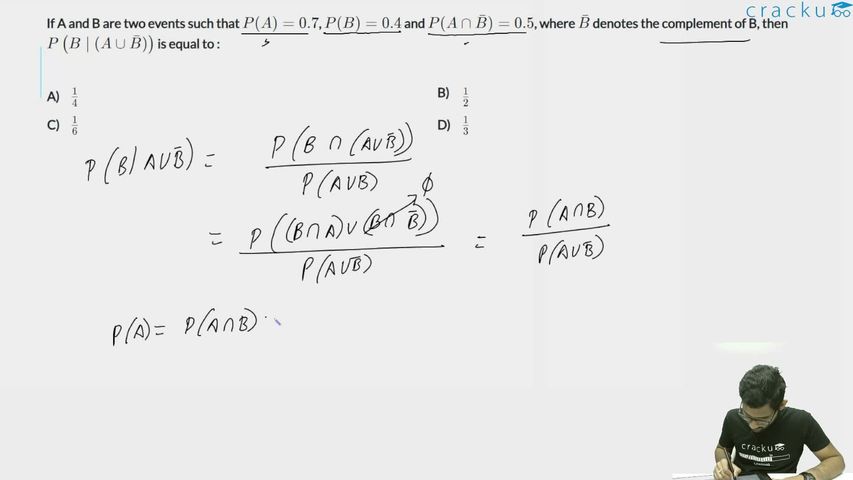
If A and B are two events such that $$P(A) = 0.7$$, $$P(B) = 0.4$$ and $$P(A \cap \bar{B}) = 0.5$$, where $$\bar{B}$$ denotes the complement of B, then $$P\left(B\mid(A \cup \bar{B})\right)$$ is equal to :
We want the conditional probability of $$B$$ given $$A \cup \bar{B}$$, written as $$P\left(B \; \bigl|\; A \cup \bar{B}\right)$$.
By definition of conditional probability,
$$P\left(B \;\bigl|\; A \cup \bar{B}\right)=\dfrac{P\!\left(B \cap (A \cup \bar{B})\right)}{P\!\left(A \cup \bar{B}\right)} \quad -(1)$$
Step 1: Simplify the numerator
Inside the intersection, $$B \cap (A \cup \bar{B}) = (B \cap A)\, \cup\, (B \cap \bar{B})$$.
But $$B \cap \bar{B} = \varnothing$$, so
$$B \cap (A \cup \bar{B}) = A \cap B \quad -(2)$$
Hence the numerator in $$(1)$$ is $$P(A \cap B)$$.
Step 2: Find $$P(A \cap B)$$
Use $$P(A)=P(A \cap B)+P(A \cap \bar{B}) \quad -(3)$$.
Given $$P(A)=0.7$$ and $$P(A \cap \bar{B})=0.5$$, substitute in $$(3)$$:
$$P(A \cap B)=0.7-0.5=0.2 \quad -(4)$$
Step 3: Find $$P(A \cup \bar{B})$$ (the denominator)
The addition theorem states
$$P(A \cup \bar{B}) = P(A) + P(\bar{B}) - P(A \cap \bar{B}) \quad -(5)$$
We already know $$P(A)=0.7$$ and $$P(A \cap \bar{B})=0.5$$. Also, $$P(\bar{B}) = 1 - P(B) = 1 - 0.4 = 0.6$$.
Substitute into $$(5)$$:
$$P(A \cup \bar{B}) = 0.7 + 0.6 - 0.5 = 0.8 \quad -(6)$$
Step 4: Compute the conditional probability
Insert $$(4)$$ and $$(6)$$ into $$(1)$$:
$$P\left(B \; \bigl|\; A \cup \bar{B}\right)=\dfrac{0.2}{0.8}=0.25=\dfrac{1}{4}$$
Therefore, the required probability equals $$\dfrac{1}{4}$$.
Hence, Option A is correct.
Was this solution helpful?
Click on the Email ☝️ to Watch the Video Solution
Create a FREE account and get:
_1.webp)

Educational materials for JEE preparation

Ask our AI anything

AI can make mistakes. Please verify important information.
AI can make mistakes. Please verify important information.
