
Join Our JEE Preparation Group
Prep with like-minded aspirants; Get access to free daily tests and study material.
Sign in
Please select an account to continue using cracku.in
↓ →
Join Our JEE Preparation Group
Prep with like-minded aspirants; Get access to free daily tests and study material.
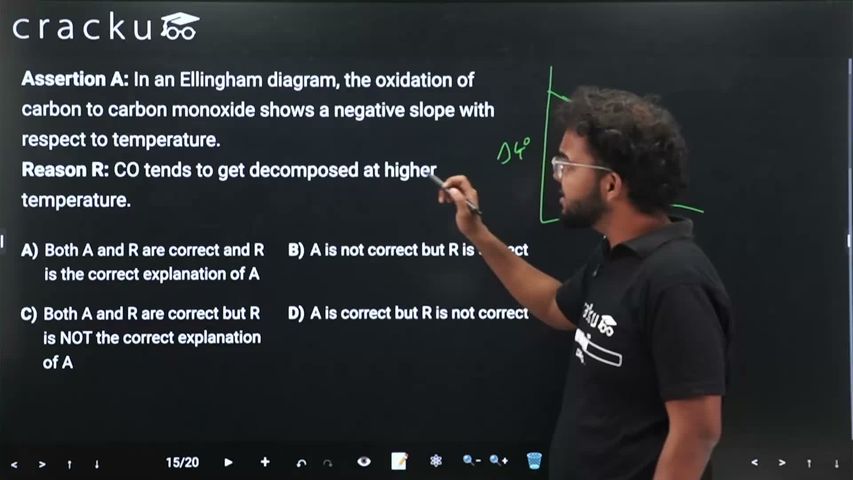
Given below are two statements:
Assertion A: In an Ellingham diagram, the oxidation of carbon to carbon monoxide shows a negative slope with respect to temperature.
Reason R: CO tends to get decomposed at higher temperature.
In the Ellingham diagram, the reaction $$2C(s) + O_2(g) \to 2CO(g)$$ has $$\Delta n_g = 2 - 1 = +1$$ (an increase in gas moles). By the relation $$\Delta G = \Delta H - T\Delta S$$, an increase in gaseous moles means $$\Delta S > 0$$, so the $$-T\Delta S$$ term becomes more negative with increasing temperature. This causes $$\Delta G$$ to decrease (become more negative) as temperature rises, giving the line a negative slope. Therefore, Assertion A is correct.
Reason R claims that CO tends to get decomposed at higher temperature. This is incorrect — in fact, the negative slope of the Ellingham line for CO formation means that CO becomes more thermodynamically stable at higher temperatures, not less. CO does not decompose at higher temperatures; rather, it is favoured as a reducing agent at elevated temperatures precisely because of this trend.
Since A is correct but R is not correct, the answer is Option D.
Was this solution helpful?
Click on the Email ☝️ to Watch the Video Solution
Create a FREE account and get:
_1.webp)

Educational materials for JEE preparation

Ask our AI anything

AI can make mistakes. Please verify important information.
AI can make mistakes. Please verify important information.
