
Join Our JEE Preparation Group
Prep with like-minded aspirants; Get access to free daily tests and study material.
Sign in
Please select an account to continue using cracku.in
↓ →
Join Our JEE Preparation Group
Prep with like-minded aspirants; Get access to free daily tests and study material.
For the reaction sequence given below, the correct statement(s) is(are)
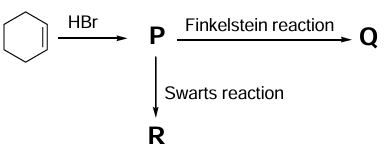
(In the options, X is any atom other than carbon and hydrogen, and it is different in P, Q and R)
The given reaction sequence converts an alcohol first into three different alkides P, Q and R in which the carbon is attached to three different hetero-atoms X.
For alcoholic substrates the most common choices of X that are introduced by standard laboratory reagents are the halogens F, Cl and Br.
Hence we set
$$P : \;\; \text{R-Cl}, \qquad Q : \;\; \text{R-Br}, \qquad R : \;\; \text{R-F}$$
All four statements can now be examined one by one.
Case 1 - C-X bond length
Within one row the bond length increases with the size (atomic radius) of the halogen:
$$\text{C-F} (1.35\;\text{Å}) \lt \text{C-Cl} (1.78\;\text{Å}) \lt \text{C-Br} (1.94\;\text{Å}).$$
Therefore
$$\text{C-X length : } Q(\text{Br}) \gt P(\text{Cl}) \gt R(\text{F}).$$
Option A claims a different order (Q > R > P), hence A is incorrect.
Case 2 - C-X bond enthalpy
Bond enthalpy falls as the halogen becomes larger and the orbital overlap weakens:
$$\text{C-F} \;(485\;\text{kJ mol}^{-1}) \gt \text{C-Cl} \;(327\;\text{kJ mol}^{-1}) \gt \text{C-Br} \;(285\;\text{kJ mol}^{-1}).$$
Thus
$$\text{C-X enthalpy : } R(\text{F}) \gt P(\text{Cl}) \gt Q(\text{Br}).$$
This matches Option B exactly, so B is correct.
Case 3 - Relative S$$\mathbf{N}$$2 reactivity
The rate of an S$$\mathbf{N}$$2 reaction depends mainly on how good the leaving group X$$^-$$ is. A better leaving group corresponds to a weaker C-X bond and a stronger conjugate acid HX (lower p$$K_a$$). Hence
$$\text{Br}^- \;(\text{best}) \gt \text{Cl}^- \gg \text{F}^-.$$
Consequently
$$\text{Reactivity : } Q(\text{Br}) \gt P(\text{Cl}) \gg R(\text{F}).$$
Option C proposes P > R > Q, which is the reverse trend, so C is incorrect.
Case 4 - p$$K_a$$ of the conjugate acids
$$pK_a(\text{HF}) \approx 3.2, \qquad pK_a(\text{HCl}) \approx -7, \qquad pK_a(\text{HBr}) \approx -9.$$
Larger (less negative) p$$K_a$$ means the acid is weaker:
$$pK_a : R(\text{HF}) \gt P(\text{HCl}) \gt Q(\text{HBr}).$$
Option D expects R > Q > P, so it is also incorrect.
Only Option B satisfies the correct order in its entirety.
Answer - Option B which is: C-X bond enthalpy in P, Q and R follows the order R > P > Q.
Was this solution helpful?
Create a FREE account and get:
_1.webp)

Educational materials for JEE preparation

Ask our AI anything

AI can make mistakes. Please verify important information.
AI can make mistakes. Please verify important information.
