
Join Our JEE Preparation Group
Prep with like-minded aspirants; Get access to free daily tests and study material.
Sign in
Please select an account to continue using cracku.in
↓ →
Join Our JEE Preparation Group
Prep with like-minded aspirants; Get access to free daily tests and study material.
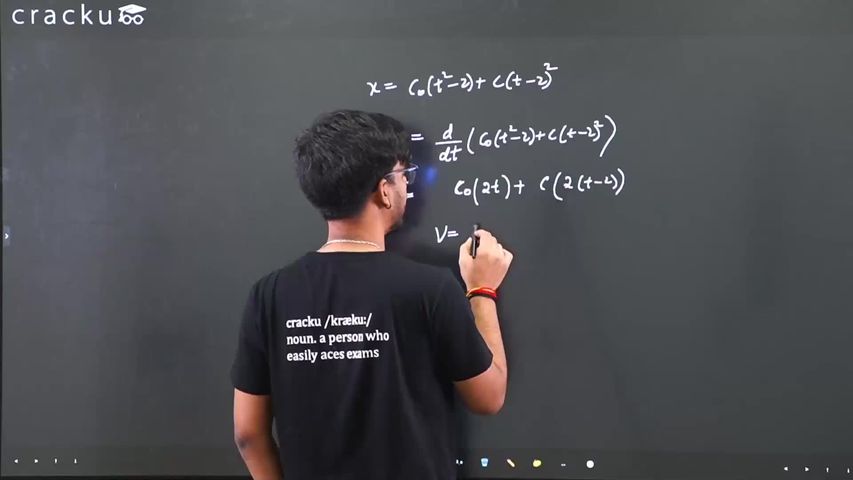
A particle moves along the x-axis and has its displacement x varying with time t according to the equation $$x = c_0(t^2 - 2) + c(t - 2)^2$$ where $$c_0$$ and $$c$$ are constants of appropriate dimensions. Then, which of the following statements is correct?
The displacement of the particle is given as
$$x = c_0\,(t^{2}-2) + c\,(t-2)^{2} \qquad -(1)$$
Step 1 - Find velocity
Velocity is the time-derivative of displacement:
$$v = \frac{dx}{dt}$$
Differentiating $$-(1)$$ term by term:
• For $$c_0\,(t^{2}-2)$$: $$\frac{d}{dt}\big(c_0\,(t^{2}-2)\big)=c_0\,(2t)=2c_0t$$
• For $$c\,(t-2)^{2}$$: $$\frac{d}{dt}\big(c\,(t-2)^{2}\big)=c\,(2\,(t-2))=2c\,(t-2)$$
Therefore
$$v = 2c_0t + 2c\,(t-2) \qquad -(2)$$
Step 2 - Find acceleration
Acceleration is the time-derivative of velocity:
$$a = \frac{dv}{dt}$$
Differentiating $$-(2)$$:
• $$\frac{d}{dt}\big(2c_0 t\big)=2c_0$$
• $$\frac{d}{dt}\big(2c\,(t-2)\big)=2c$$
Hence
$$a = 2c_0 + 2c = 2\,(c_0 + c) \qquad -(3)$$
Acceleration is a constant equal to $$2(c_0 + c)$$.
Step 3 - Check other statements
Initial velocity (at $$t=0$$) from $$-(2)$$:
$$v(0)=2c_0\,(0) + 2c\,(0-2) = -4c$$
Thus the initial velocity is $$-4c$$, not $$4c$$.
Conclusion
From $$-(3)$$, the only correct statement is: “the acceleration of the particle is $$2(c + c_0)$$,” which corresponds to Option D.
Was this solution helpful?
Click on the Email ☝️ to Watch the Video Solution
Create a FREE account and get:
_1.webp)

Educational materials for JEE preparation

Ask our AI anything

AI can make mistakes. Please verify important information.
AI can make mistakes. Please verify important information.
