
Join Our JEE Preparation Group
Prep with like-minded aspirants; Get access to free daily tests and study material.
Sign in
Please select an account to continue using cracku.in
↓ →
Join Our JEE Preparation Group
Prep with like-minded aspirants; Get access to free daily tests and study material.
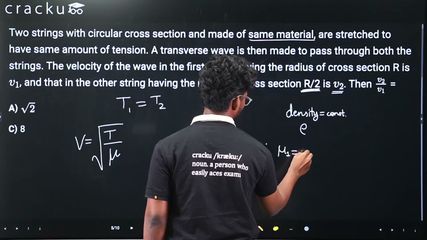
Two strings with circular cross section and made of same material, are stretched to have same amount of tension. A transverse wave is then made to pass through both the strings. The velocity of the wave in the first string having the radius of cross section R is $$v_1$$, and that in the other string having the radius of cross section R/2 is $$v_2$$. Then $$\frac{v_2}{v_1}$$ =
The speed of a transverse wave on a stretched string is given by the fundamental relation
$$v = \sqrt{\dfrac{T}{\mu}}$$ where $$T$$ is the tension and $$\mu$$ is the mass per unit length of the string.
Because both strings are made of the same material and carry the same tension $$T$$, the only quantity that changes from one string to the other is $$\mu$$.
For a string of density $$\rho$$ (mass per unit volume) and circular cross-section of radius $$R$$, the cross-sectional area is
$$A = \pi R^{2}$$.
Hence,
$$\mu = \rho A = \rho \pi R^{2} \;-\!(1)$$
Case 1: Radius $$R$$
Using $$(1)$$, $$\mu_1 = \rho \pi R^{2}$$.
Therefore,
$$v_1 = \sqrt{\dfrac{T}{\mu_1}} = \sqrt{\dfrac{T}{\rho \pi R^{2}}} \;-\!(2)$$
Case 2: Radius $$\dfrac{R}{2}$$
New area: $$A_2 = \pi \left(\dfrac{R}{2}\right)^{2} = \dfrac{\pi R^{2}}{4}$$.
Thus,
$$\mu_2 = \rho A_2 = \rho \dfrac{\pi R^{2}}{4} = \dfrac{\mu_1}{4} \;-\!(3)$$
Wave speed in the second string:
$$v_2 = \sqrt{\dfrac{T}{\mu_2}}$$.
Substitute $$\mu_2$$ from $$(3)$$:
$$v_2 = \sqrt{\dfrac{T}{\mu_1/4}} = \sqrt{\dfrac{4T}{\mu_1}} = 2\sqrt{\dfrac{T}{\mu_1}} \;-\!(4)$$
Compare $$(4)$$ with $$(2)$$: $$v_1 = \sqrt{\dfrac{T}{\mu_1}}$$.
Therefore,
$$\dfrac{v_2}{v_1} = \dfrac{2\sqrt{T/\mu_1}}{\sqrt{T/\mu_1}} = 2$$.
Hence $$\dfrac{v_2}{v_1} = 2$$.
Correct option: Option B.
Was this solution helpful?
Click on the Email ☝️ to Watch the Video Solution
Create a FREE account and get:
_1.webp)

Educational materials for JEE preparation

Ask our AI anything

AI can make mistakes. Please verify important information.
AI can make mistakes. Please verify important information.
