
Join Our JEE Preparation Group
Prep with like-minded aspirants; Get access to free daily tests and study material.
Sign in
Please select an account to continue using cracku.in
↓ →
Join Our JEE Preparation Group
Prep with like-minded aspirants; Get access to free daily tests and study material.
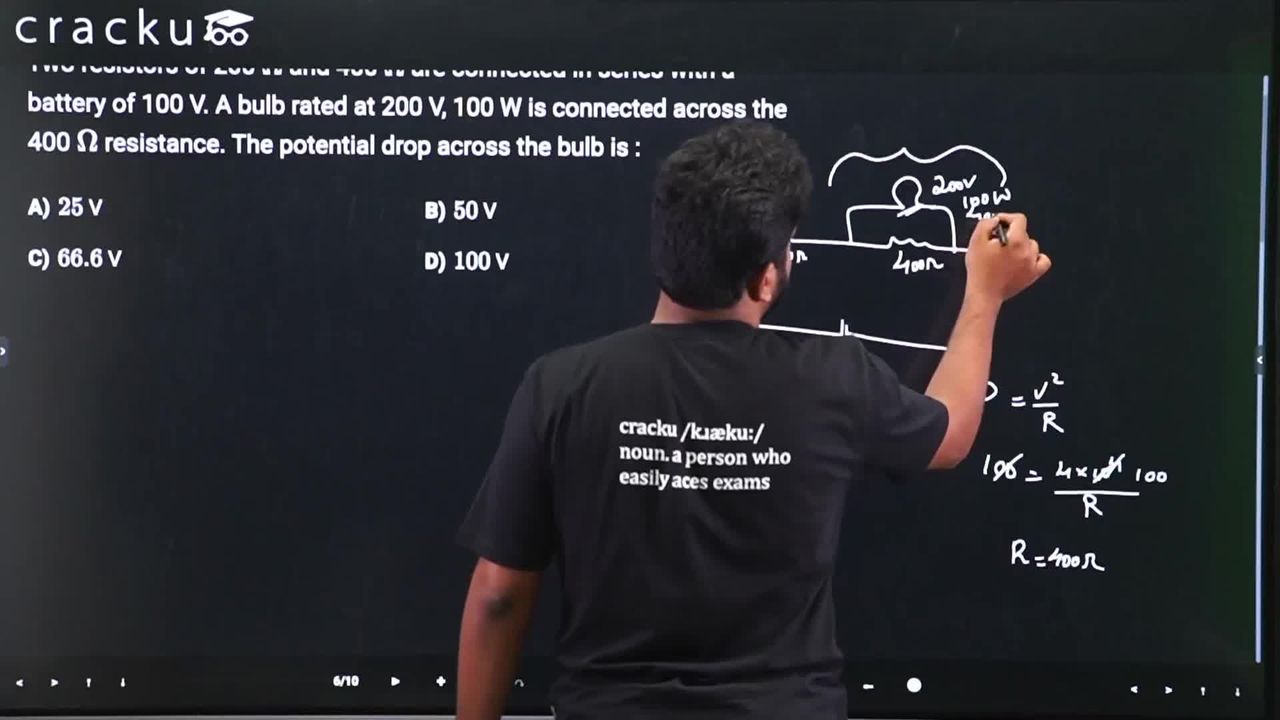
Two resistors of 200 $$\Omega$$ and 400 $$\Omega$$ are connected in series with a battery of 100 V. A bulb rated at 200 V, 100 W is connected across the 400 $$\Omega$$ resistance. The potential drop across the bulb is :
The bulb is not connected directly across the battery; it is placed in parallel with the $$400\;\Omega$$ resistor, and this parallel pair is in series with the $$200\;\Omega$$ resistor and the 100 V source.
Step 1 Find the resistance of the bulb.
The rating 200 V, 100 W means the bulb draws 100 W when 200 V is applied.
Using $$P = \frac{V^{2}}{R}$$, the resistance of the bulb is
$$R_{b} = \frac{(200)^{2}}{100} = 400\;\Omega$$.
Step 2 Find the equivalent resistance of the parallel branch.
The bulb ($$R_{b}=400\;\Omega$$) is in parallel with the given $$400\;\Omega$$ resistor $$R_{2}$$.
For two equal resistances in parallel,
$$R_{\text{parallel}} = \frac{R_{b}\,R_{2}}{R_{b}+R_{2}}
= \frac{400 \times 400}{400+400}
= \frac{160000}{800}
= 200\;\Omega$$.
Step 3 Find the total resistance seen by the battery.
This parallel combination ($$200\;\Omega$$) is in series with the $$200\;\Omega$$ resistor $$R_{1}$$:
$$R_{\text{total}} = R_{1} + R_{\text{parallel}}
= 200 + 200
= 400\;\Omega$$.
Step 4 Calculate the circuit current.
Using Ohm’s law with the 100 V source:
$$I = \frac{V}{R_{\text{total}}}
= \frac{100}{400}
= 0.25\;\text{A}$$.
Step 5 Find the potential drop across the bulb.
The bulb shares the same potential as its parallel partner, so
$$V_{\text{bulb}} = I \times R_{\text{parallel}}
= 0.25 \times 200
= 50\;\text{V}$$.
Hence, the potential drop across the bulb is $$50\;\text{V}$$.
Option B which is: $$50\;\text{V}$$
Click on the Email ☝️ to Watch the Video Solution
Create a FREE account and get:
_1.webp)

Educational materials for JEE preparation

Ask our AI anything

AI can make mistakes. Please verify important information.
AI can make mistakes. Please verify important information.


