
Join Our JEE Preparation Group
Prep with like-minded aspirants; Get access to free daily tests and study material.
Sign in
Please select an account to continue using cracku.in
↓ →
Join Our JEE Preparation Group
Prep with like-minded aspirants; Get access to free daily tests and study material.
The oxo-acids of phosphorus can be recognised from the general formula $$H_nP_mO_x$$ and by remembering that:
• Every hydrogen attached to oxygen appears as an $$-OH$$ group and is ionisable (acidic).
• Any hydrogen that is written directly next to phosphorus in the condensed formula is attached to phosphorus itself; that bond is a $$P-H$$ bond. Such hydrogens are non-ionisable and take part in reduction reactions.
Let us inspect each option.
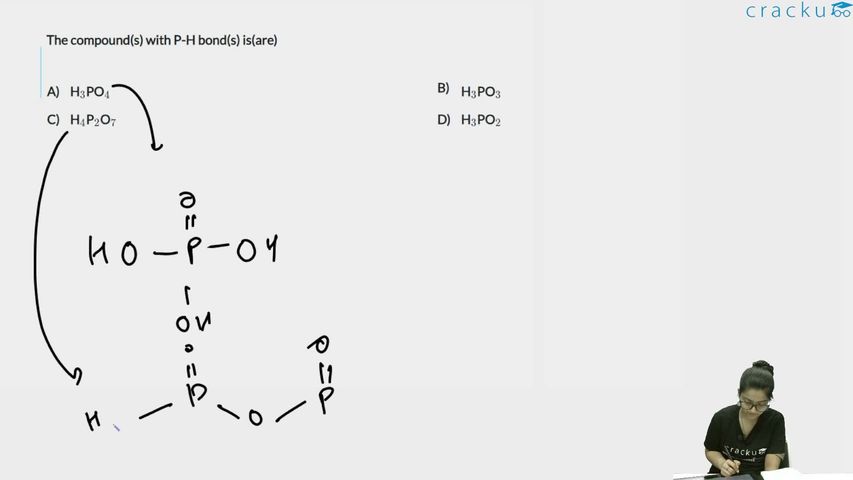
Option A : $$H_3PO_4$$ (Orthophosphoric acid)
Expanded structure: $$\;HO-P(=O)(OH)_2$$.
All three hydrogens are bonded to oxygen as $$-OH$$ groups, so there is no $$P-H$$ bond in this molecule.
Option B : $$H_3PO_3$$ (Phosphorous acid)
The correct expanded formula is $$\;P(OH)_3$$.
Here two hydrogens are bonded to oxygen ($$-OH$$ groups) and one hydrogen is directly attached to phosphorus. Therefore the molecule contains one $$P-H$$ bond.
Option C : $$H_4P_2O_7$$ (Pyrophosphoric acid)
This acid is obtained by condensation of two $$H_3PO_4$$ units: $$HO-P(=O)(OH)-O-P(=O)(OH)_2$$.
All four hydrogens appear in $$-OH$$ groups; again, no $$P-H$$ bond is present.
Option D : $$H_3PO_2$$ (Hypophosphorous acid)
Expanded structure: $$\;H_2P(=O)(OH)$$.
One hydrogen forms an $$-OH$$ group, while two hydrogens are directly attached to phosphorus. Thus the molecule contains two $$P-H$$ bonds.
Hence, the acids that contain at least one $$P-H$$ bond are:
Option D which is: $$H_3PO_2$$.
All other options lack a $$P-H$$ bond.
Final answer: Option D (H$$_3$$PO$$_2$$)
Was this solution helpful?
Click on the Email ☝️ to Watch the Video Solution
Create a FREE account and get:
_1.webp)

Educational materials for JEE preparation

Ask our AI anything

AI can make mistakes. Please verify important information.
AI can make mistakes. Please verify important information.
