
Join Our JEE Preparation Group
Prep with like-minded aspirants; Get access to free daily tests and study material.
Sign in
Please select an account to continue using cracku.in
↓ →
Join Our JEE Preparation Group
Prep with like-minded aspirants; Get access to free daily tests and study material.
For any thermodynamic process the first law of thermodynamics states
$$dQ = dU + dW$$ where
$$dQ$$ = heat supplied to the system, $$dU$$ = change in internal energy and $$dW$$ = work done by the system.
Adiabatic process: By definition no heat is exchanged with the surroundings, hence
$$dQ = 0$$ $$-(1)$$
Putting $$dQ = 0$$ in the first-law equation $$-(1)$$ gives
$$0 = dU + dW \;\;\Longrightarrow\;\; dU = -\,dW$$ $$-(2)$$
Equation $$-(2)$$ shows that the work done by the gas is numerically equal to the decrease (negative) in its internal energy, or equivalently, the increase in internal energy is numerically equal to the negative of the work done.
Now recall the definition of molar heat capacity for any path:
$$C = \frac{1}{n}\,\frac{dQ}{dT}$$ where $$n$$ is the number of moles.
For an adiabatic process $$dQ = 0$$, therefore
$$C = \frac{1}{n}\,\frac{0}{dT} = 0$$ $$-(3)$$
Hence the molar heat capacity along an adiabatic path is zero.
Let us test each option:
Option A The molar heat capacity is infinite - contradicts $$-(3)$$ (false).
Option B Work done by the gas equals the increase in internal energy - according to $$-(2)$$ the signs are opposite (false).
Option C The molar heat capacity is zero - matches $$-(3)$$ (true).
Option D The internal energy of the gas decreases as the temperature increases - no such rule exists; internal energy is directly related to temperature for an ideal gas (false).
Therefore the correct statement is Option C: the molar heat capacity in an adiabatic process is zero.
Was this solution helpful?
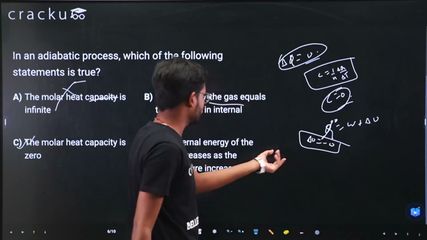
Click on the Email ☝️ to Watch the Video Solution
Create a FREE account and get:
_1.webp)

Educational materials for JEE preparation

Ask our AI anything

AI can make mistakes. Please verify important information.
AI can make mistakes. Please verify important information.


