
Join Our JEE Preparation Group
Prep with like-minded aspirants; Get access to free daily tests and study material.
Sign in
Please select an account to continue using cracku.in
↓ →
Join Our JEE Preparation Group
Prep with like-minded aspirants; Get access to free daily tests and study material.
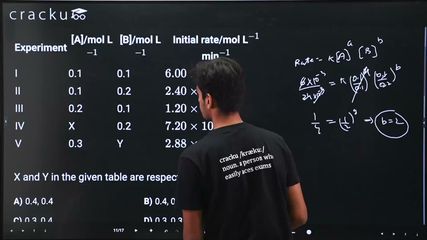
The results given in the below table were obtained during kinetic studies of the following reaction:
$$2A + B \to C + D$$
| Experiment | [A]/mol L$$^{-1}$$ | [B]/mol L$$^{-1}$$ | Initial rate/mol L$$^{-1}$$ min$$^{-1}$$ |
|---|---|---|---|
| I | 0.1 | 0.1 | $$6.00 \times 10^{-3}$$ |
| II | 0.1 | 0.2 | $$2.40 \times 10^{-2}$$ |
| III | 0.2 | 0.1 | $$1.20 \times 10^{-2}$$ |
| IV | X | 0.2 | $$7.20 \times 10^{-2}$$ |
| V | 0.3 | Y | $$2.88 \times 10^{-1}$$ |
X and Y in the given table are respectively:
For any chemical reaction of the type
$$2A + B \longrightarrow C + D$$
the empirical rate law is written as
$$\text{rate}=k\,[A]^m\,[B]^n$$
where $$k$$ is the rate constant and $$m,n$$ are the orders of the reaction with respect to $$A$$ and $$B$$ respectively. Our first goal is to determine $$m$$ and $$n$$ from the experimental data.
We start by comparing Experiments I and II. In these two runs the concentration of $$A$$ is kept the same while that of $$B$$ is doubled:
$$[A]_{\text I}=0.1,\;[A]_{\text{II}}=0.1$$
$$[B]_{\text I}=0.1,\;[B]_{\text{II}}=0.2=2\times0.1$$
The corresponding initial rates are
$$r_{\text I}=6.00\times10^{-3},\;r_{\text{II}}=2.40\times10^{-2}=4\times6.00\times10^{-3}$$
So the rate increases by a factor of $$4$$ when $$[B]$$ is doubled. Using the rate law:
$$\frac{r_{\text{II}}}{r_{\text I}}=\frac{k\,[A]^m_{\text{II}}\,[B]^n_{\text{II}}}{k\,[A]^m_{\text I}\,[B]^n_{\text I}} =\frac{[A]^m_{\text{II}}}{[A]^m_{\text I}}\; \frac{[B]^n_{\text{II}}}{[B]^n_{\text I}} =(1)\left(\frac{0.2}{0.1}\right)^n=2^n$$
The left-hand side equals $$4$$, so
$$2^n=4\;\Longrightarrow\;n=2$$
Next we compare Experiments I and III, where $$[B]$$ is kept constant and $$[A]$$ is doubled:
$$[A]_{\text I}=0.1,\;[A]_{\text{III}}=0.2=2\times0.1$$
$$[B]_{\text I}=0.1,\;[B]_{\text{III}}=0.1$$
The rates are
$$r_{\text I}=6.00\times10^{-3},\;r_{\text{III}}=1.20\times10^{-2}=2\times6.00\times10^{-3}$$
Thus
$$\frac{r_{\text{III}}}{r_{\text I}}=\left(\frac{0.2}{0.1}\right)^m=2^m=2$$
which immediately gives
$$m=1$$
Hence the complete rate law is
$$\boxed{\text{rate}=k\,[A]^1\,[B]^2}$$
To find the numerical value of $$k$$ we substitute data from any experiment, say Experiment I:
$$6.00\times10^{-3}=k\,(0.1)\,(0.1)^2=k\,(0.1)(0.01)=k\,(0.001)$$
$$\Rightarrow\;k=\frac{6.00\times10^{-3}}{1.00\times10^{-3}}=6.0$$
Now we use this rate constant to determine the missing concentrations.
Experiment IV
$$\text{rate}=7.20\times10^{-2},\;[B]=0.2,\;k=6.0,\;[A]=X$$
Substituting in the rate law:
$$7.20\times10^{-2}=6.0\;(X)\;(0.2)^2=6.0\;X\;(0.04)=0.24\,X$$
$$\Rightarrow\;X=\frac{7.20\times10^{-2}}{0.24}=0.30$$
Experiment V
$$\text{rate}=2.88\times10^{-1},\;[A]=0.3,\;k=6.0,\;[B]=Y$$
Substituting:
$$2.88\times10^{-1}=6.0\;(0.3)\;Y^2=1.8\,Y^2$$
$$\Rightarrow\;Y^2=\frac{2.88\times10^{-1}}{1.8}=0.16$$
$$\Rightarrow\;Y=\sqrt{0.16}=0.40$$
Thus we obtain
$$X=0.3,\qquad Y=0.4$$
Hence, the correct answer is Option C.
Was this solution helpful?
Click on the Email ☝️ to Watch the Video Solution
Create a FREE account and get:
_1.webp)

Educational materials for JEE preparation

Ask our AI anything

AI can make mistakes. Please verify important information.
AI can make mistakes. Please verify important information.


