
Join Our JEE Preparation Group
Prep with like-minded aspirants; Get access to free daily tests and study material.
Sign in
Please select an account to continue using cracku.in
↓ →
Join Our JEE Preparation Group
Prep with like-minded aspirants; Get access to free daily tests and study material.
List I contains four combinations of two lenses (1 and 2) whose focal lengths (in cm) are indicated in the figures. In all cases, the object is placed 20 cm from the first lens on the left, and the distance between the two lenses is 5 cm. List II contains the positions of the final images.
| List-I | List-II |
|---|---|
(I) 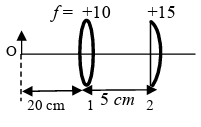 | (P) Final image is formed at 7.5 cm on the right side of lens 2. |
(II)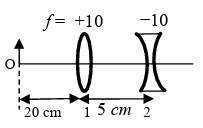 | (Q) Final image is formed at 60.0 cm on the right side of lens 2. |
(III) 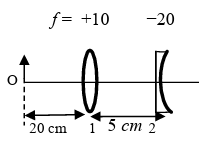 | (R) Final image is formed at 30.0 cm on the left side of lens 2. |
(IV) 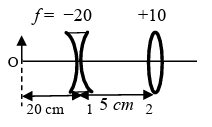 | (S) Final image is formed at 6.0 cm on the right side of lens 2. |
| (T) Final image is formed at 30.0 cm on the right side of lens 2. |
Which one of the following options is correct?
For every combination of the two-lens system we shall use the Cartesian sign convention and the thin-lens formula
$$\frac1v - \frac1u = \frac1f \qquad\text{-(1)}$$
Here $$u$$ is the object distance from the lens, $$v$$ the image distance from the lens (both measured from the lens‐centre, positive to the right), and $$f$$ the focal length (positive for a converging lens, negative for a diverging lens).
The lenses are 5 cm apart and in each case the original object is 20 cm to the left of lens 1, so $$u_1 = -20\text{ cm}$$ for every combination.
Lens 1: $$u_1 = -20\text{ cm},\; f_1 = +20\text{ cm}$$
Using (1): $$\frac1{v_1} = \frac1{20} + \frac1{-20} = 0 \;\Rightarrow\; v_1 = +\infty$$
Rays emerging from lens 1 are parallel, so for lens 2 the object is at infinity: $$u_2 = -\infty$$.
Lens 2 therefore forms the image at its own focus:
$$v_2 = f_2 = +7.5\text{ cm}$$ (to the right of lens 2).
Hence the final image position matches item P.
Lens 1: $$u_1 = -20\text{ cm},\; f_1 = +10\text{ cm}$$
$$\frac1{v_1} = \frac1{10} + \frac1{-20} = \frac1{20}\;\Rightarrow\; v_1 = +20\text{ cm}$$
This image lies 20 cm to the right of lens 1. The two lenses are 5 cm apart, therefore the object distance for lens 2 is
$$u_2 = -(20 - 5) = -15\text{ cm}$$
Lens 2: $$f_2 = +30\text{ cm}$$
$$\frac1{v_2} = \frac1{30} + \frac1{-15} = \frac1{30} - \frac2{30} = -\frac1{30}$$
$$\therefore\; v_2 = -30\text{ cm}$$ (30 cm to the left of lens 2).
Thus the final image corresponds to item R.
Lens 1: $$u_1 = -20\text{ cm},\; f_1 = +20\text{ cm}$$
Again $$v_1 = +\infty$$, so the rays reaching lens 2 are parallel: $$u_2 = -\infty$$.
Lens 2 therefore brings them to focus at
$$v_2 = f_2 = +60\text{ cm}$$ (to the right of lens 2).
This matches item Q.
Lens 1: $$u_1 = -20\text{ cm},\; f_1 = +10\text{ cm}$$
$$\frac1{v_1} = \frac1{10} + \frac1{-20} = \frac1{20}\;\Rightarrow\; v_1 = +20\text{ cm}$$
Hence $$u_2 = -(20 - 5) = -15\text{ cm}$$ for lens 2.
Lens 2: $$f_2 = +10\text{ cm}$$
$$\frac1{v_2} = \frac1{10} + \frac1{-15} = \frac3{30} - \frac2{30} = \frac1{30}$$
$$\therefore\; v_2 = +30\text{ cm}$$ (to the right of lens 2).
Thus the final image position coincides with item T.
Summarising the results:
I → P (7.5 cm to the right of lens 2)
II → R (30 cm to the left of lens 2)
III → Q (60 cm to the right of lens 2)
IV → T (30 cm to the right of lens 2)
The only option giving this correspondence is
Option A: I → P, II → R, III → Q, IV → T.
Create a FREE account and get:
_1.webp)

Educational materials for JEE preparation

Ask our AI anything

AI can make mistakes. Please verify important information.
AI can make mistakes. Please verify important information.


