
Join Our JEE Preparation Group
Prep with like-minded aspirants; Get access to free daily tests and study material.
Sign in
Please select an account to continue using cracku.in
↓ →
Join Our JEE Preparation Group
Prep with like-minded aspirants; Get access to free daily tests and study material.
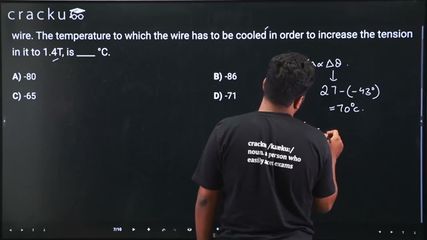
A brass wire of length 2 m and radius 1 mm at 27 °C is held taut between two rigid supports. Initially, it was cooled to a temperature of -43 °C, creating a tension T in the wire. The temperature to which the wire has to be cooled in order to increase the tension in it to 1.4T, is ____ °C.
We need to find the temperature to which a brass wire must be cooled to increase its tension from $$T$$ to $$1.4T$$.
Since when a wire held between rigid supports is cooled it tries to contract but cannot, a thermal stress develops, producing a tension given by $$T = YA\alpha\Delta\theta$$, where $$Y$$ = Young's modulus, $$A$$ = cross-sectional area, $$\alpha$$ = coefficient of linear expansion, and $$\Delta\theta$$ = temperature change.
Initially the wire is at 27°C and is cooled to -43°C, so $$\Delta\theta_1 = 27 - (-43) = 70°C$$; substituting into the tension expression gives $$T = YA\alpha \times 70$$.
For the increased tension $$1.4T$$ we therefore have $$1.4T = YA\alpha \times \Delta\theta_2$$.
Dividing these equations yields $$\frac{1.4T}{T} = \frac{\Delta\theta_2}{70}$$ and hence $$\Delta\theta_2 = 1.4 \times 70 = 98°C$$.
This means the wire must be cooled from 27°C by 98°C, giving $$\theta = 27 - 98 = -71°C$$. Therefore, the required temperature is Option 4: -71°C.
Was this solution helpful?
Click on the Email ☝️ to Watch the Video Solution
Create a FREE account and get:
_1.webp)

Educational materials for JEE preparation

Ask our AI anything

AI can make mistakes. Please verify important information.
AI can make mistakes. Please verify important information.
