
Join Our JEE Preparation Group
Prep with like-minded aspirants; Get access to free daily tests and study material.
Sign in
Please select an account to continue using cracku.in
↓ →
Join Our JEE Preparation Group
Prep with like-minded aspirants; Get access to free daily tests and study material.
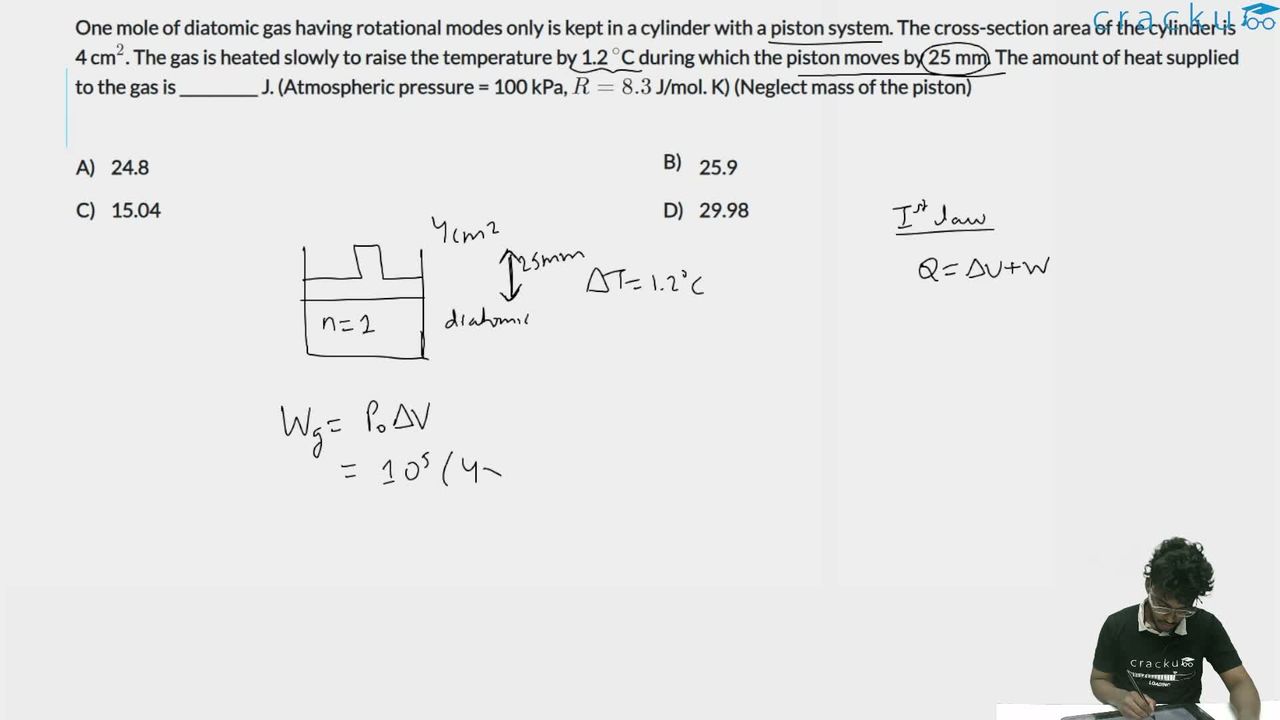
One mole of diatomic gas having rotational modes only is kept in a cylinder with a piston system. The cross-section area of the cylinder is 4 cm$$^2$$. The gas is heated slowly to raise the temperature by 1.2 $$^\circ$$C during which the piston moves by 25 mm. The amount of heat supplied to the gas is __________ J. (Atmospheric pressure = 100 kPa, $$R = 8.3$$ J/mol. K) (Neglect mass of the piston)
Solution :
For one mole of diatomic gas with rotational modes only :
$$C_v = \frac{5R}{2}$$
Therefore,
$$C_p = C_v + R$$
$$= \frac{5R}{2} + R$$
$$= \frac{7R}{2}$$
Given :
$$n = 1$$
Temperature rise :
$$\Delta T = 1.2^\circ\text{C} = 1.2\text{ K}$$
Cross-sectional area :
$$A = 4\text{ cm}^2$$
$$= 4 \times 10^{-4}\text{ m}^2$$
Displacement of piston :
$$x = 25\text{ mm}$$
$$= 25 \times 10^{-3}\text{ m}$$
Change in volume :
$$\Delta V = Ax$$
$$= (4 \times 10^{-4})(25 \times 10^{-3})$$
$$= 10^{-5}\text{ m}^3$$
Atmospheric pressure :
$$P = 100\text{ kPa}$$
$$= 10^5\text{ Pa}$$
Work done :
$$W = P\Delta V$$
$$= 10^5 \times 10^{-5}$$
$$= 1\text{ J}$$
Heat supplied :
$$Q = nC_v\Delta T + W$$
$$= 1 \times \frac{5 \times 8.3}{2} \times 1.2 + 1$$
$$= 24.9 + 1$$
$$= 25.9\text{ J}$$
Final Answer :
$$25.9\text{ J}$$
Was this solution helpful?
Click on the Email ☝️ to Watch the Video Solution
Create a FREE account and get:
_1.webp)

Educational materials for JEE preparation

Ask our AI anything

AI can make mistakes. Please verify important information.
AI can make mistakes. Please verify important information.
