
Join Our JEE Preparation Group
Prep with like-minded aspirants; Get access to free daily tests and study material.
Sign in
Please select an account to continue using cracku.in
↓ →
Join Our JEE Preparation Group
Prep with like-minded aspirants; Get access to free daily tests and study material.
Monocyclic compounds P, Q, R and S are the major products formed in the reaction sequences given below.
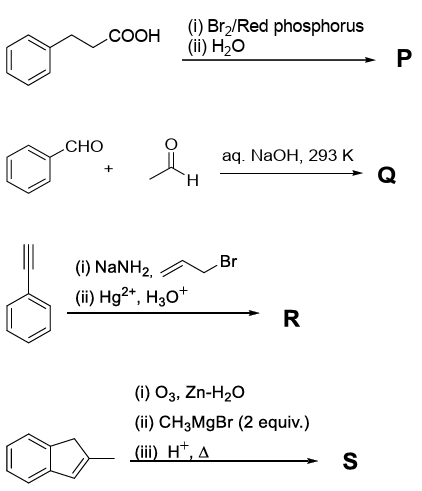
The product having the highest number of unsaturated carbon atom(s) is
An “unsaturated” carbon is any carbon that is part of a multiple bond (C=C or C≡C).
Therefore, to compare P, Q, R and S we must first identify the ring produced in each sequence and then count the sp2/sp hybridised carbons present in that ring.
Case 1 : Formation of P
The dihydric alcohol supplied in sequence (1) undergoes intramolecular dehydration with conc. $$H_2SO_4$$ to give a saturated cyclic ether (tetrahydrofuran type).
All ring carbons remain $$sp^3$$-hybridised, so
Number of unsaturated carbons in P = 0
Case 2 : Formation of Q
In sequence (2) the diol first forms a leaving-group derivative, followed by a single E2 elimination, producing a cyclohexene ring with one C=C bond.
Only the two carbons of that double bond are $$sp^2$$; hence
Number of unsaturated carbons in Q = 2
Case 3 : Formation of R
Sequence (3) involves two eliminations that furnish a conjugated diene ring, cyclohexa-1,3-diene. Two C=C bonds ⟹ four $$sp^2$$ carbons, so
Number of unsaturated carbons in R = 4
Case 4 : Formation of S
The reagents in sequence (4) carry out stepwise dehydrogenation until an aromatic ring is obtained. The monocyclic product is benzene (or a benzene derivative), which contains six $$sp^2$$ carbons.
Therefore,
Number of unsaturated carbons in S = 6
Comparing: $$P:0 \lt Q:2 \lt R:4 \lt S:6$$
Hence, the product possessing the largest number of unsaturated carbon atoms is S.
Option D which is: S
Create a FREE account and get:
_1.webp)

Educational materials for JEE preparation

Ask our AI anything

AI can make mistakes. Please verify important information.
AI can make mistakes. Please verify important information.


