
Join Our JEE Preparation Group
Prep with like-minded aspirants; Get access to free daily tests and study material.
Sign in
Please select an account to continue using cracku.in
↓ →
Join Our JEE Preparation Group
Prep with like-minded aspirants; Get access to free daily tests and study material.
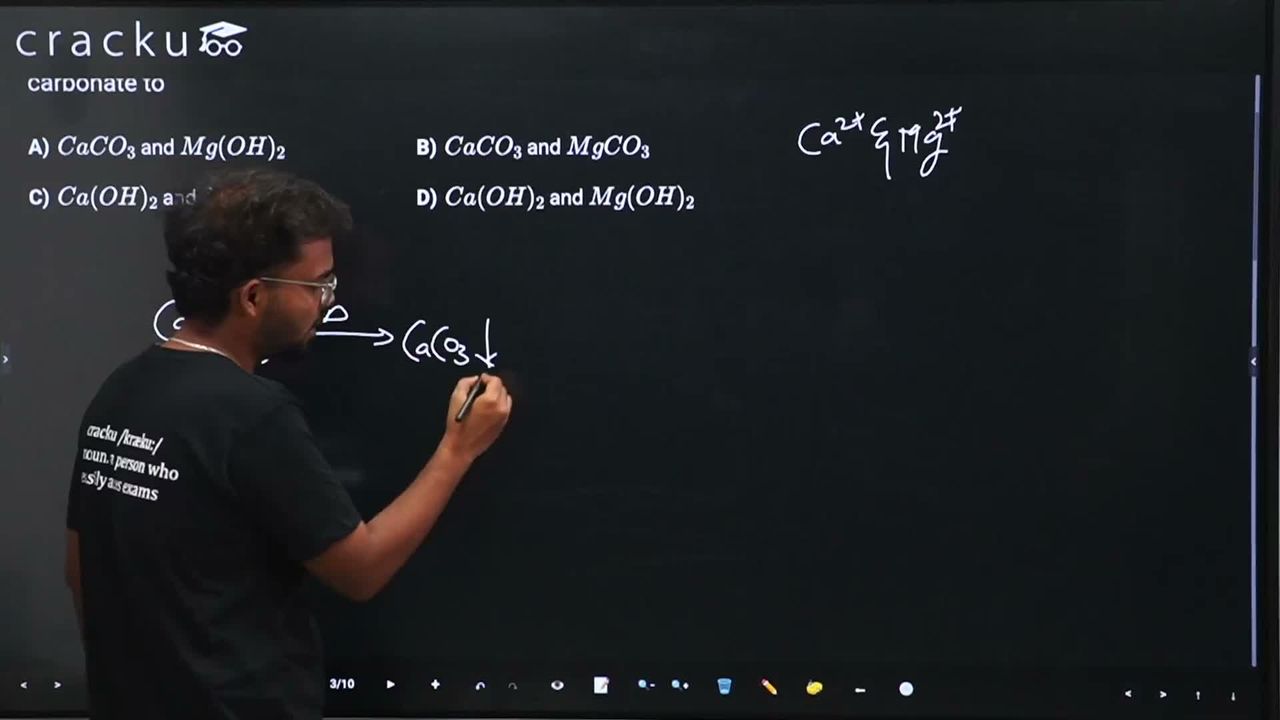
Boiling of hard water is helpful in removing the temporary hardness by converting calcium hydrogen carbonate and magnesium hydrogen carbonate to
We need to determine the products formed when temporary hard water is boiled.
Temporary hardness is caused by the presence of calcium hydrogen carbonate $$Ca(HCO_3)_2$$ and magnesium hydrogen carbonate $$Mg(HCO_3)_2$$.
For calcium hydrogen carbonate:
$$Ca(HCO_3)_2 \xrightarrow{\Delta} CaCO_3 \downarrow + H_2O + CO_2 \uparrow$$
Calcium hydrogen carbonate decomposes to give insoluble calcium carbonate.
For magnesium hydrogen carbonate:
$$Mg(HCO_3)_2 \xrightarrow{\Delta} Mg(OH)_2 \downarrow + 2CO_2 \uparrow$$
Magnesium hydrogen carbonate, on prolonged boiling, gives magnesium hydroxide (not magnesium carbonate), because $$MgCO_3$$ is more soluble and further decomposes.
The products are $$CaCO_3$$ and $$Mg(OH)_2$$.
The correct answer is Option A: $$CaCO_3$$ and $$Mg(OH)_2$$.
Was this solution helpful?
Click on the Email ☝️ to Watch the Video Solution
Create a FREE account and get:
_1.webp)

Educational materials for JEE preparation

Ask our AI anything

AI can make mistakes. Please verify important information.
AI can make mistakes. Please verify important information.
