
Join Our JEE Preparation Group
Prep with like-minded aspirants; Get access to free daily tests and study material.
Sign in
Please select an account to continue using cracku.in
↓ →
Join Our JEE Preparation Group
Prep with like-minded aspirants; Get access to free daily tests and study material.
Match the LIST-I with LIST-II.
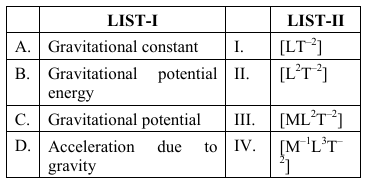
Choose the correct answer from the options given below :
The four physical quantities are gravitational constant $$G$$, gravitational potential energy $$U$$, gravitational potential $$V$$ and acceleration due to gravity $$g$$. We first write the defining equations for each quantity and then extract their dimensional formulas.
Case A : Gravitational constant $$G$$
Newton’s law gives the gravitational force between two masses $$m_1$$ and $$m_2$$ separated by distance $$r$$ as
$$F = \dfrac{G\,m_1\,m_2}{r^{2}}$$
Re-arranging,
$$G = \dfrac{F\,r^{2}}{m_1\,m_2}$$
Force has dimensions $$[MLT^{-2}]$$. Hence
$$[G] = \dfrac{[MLT^{-2}]\,L^{2}}{M\,M} = [M^{-1}L^{3}T^{-2}]$$
Case B : Gravitational potential energy $$U$$
Potential energy near Earth’s surface is $$U = mgh$$.
Mass $$m$$ has $$[M]$$, $$g$$ has $$[LT^{-2}]$$ and height $$h$$ has $$[L]$$. Therefore
$$[U] = [M]\,[LT^{-2}]\,[L] = [ML^{2}T^{-2}]$$
Case C : Gravitational potential $$V$$
Potential is energy per unit mass: $$V = \dfrac{U}{m}$$.
Divide the dimensions of $$U$$ obtained above by $$[M]$$:
$$[V] = \dfrac{[ML^{2}T^{-2}]}{[M]} = [L^{2}T^{-2}]$$
Case D : Acceleration due to gravity $$g$$
Acceleration is rate of change of velocity: $$g = \dfrac{dv}{dt}$$.
Velocity $$v$$ has $$[LT^{-1}]$$, so acceleration has
$$[g] = \dfrac{[LT^{-1}]}{[T]} = [LT^{-2}]$$
Now compare with LIST-II:
I. $$[LT^{-2}]$$ II. $$[L^{2}T^{-2}]$$ III. $$[ML^{2}T^{-2}]$$ IV. $$[M^{-1}L^{3}T^{-2}]$$
Matching each quantity with its dimensional formula:
A. $$G$$ ⟶ IV B. $$U$$ ⟶ III C. $$V$$ ⟶ II D. $$g$$ ⟶ I
Thus the correct set is A-IV, B-III, C-II, D-I, which corresponds to Option A.
Was this solution helpful?
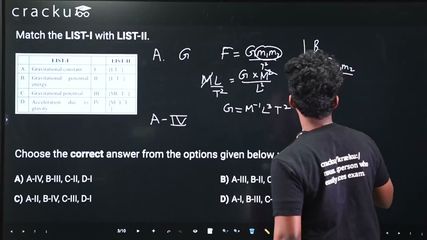
Click on the Email ☝️ to Watch the Video Solution
Create a FREE account and get:
_1.webp)

Educational materials for JEE preparation

Ask our AI anything

AI can make mistakes. Please verify important information.
AI can make mistakes. Please verify important information.


