
Join Our JEE Preparation Group
Prep with like-minded aspirants; Get access to free daily tests and study material.
Sign in
Please select an account to continue using cracku.in
↓ →
Join Our JEE Preparation Group
Prep with like-minded aspirants; Get access to free daily tests and study material.
Given below are two statements : one is labelled as Assertion (A) and the other is labelled as Reason (R).
Assertion (A): Lithium salts are hydrated.
Reason (R): Lithium has higher polarising power than other alkali metal group members.
In the light of the above statements, choose the most appropriate answer from the options given below:
We have to judge the truth of both statements and also decide whether the Reason really explains the Assertion. Let us examine them one by one, carrying every algebraic and conceptual step along.
First, consider the Assertion (A): “Lithium salts are hydrated.”
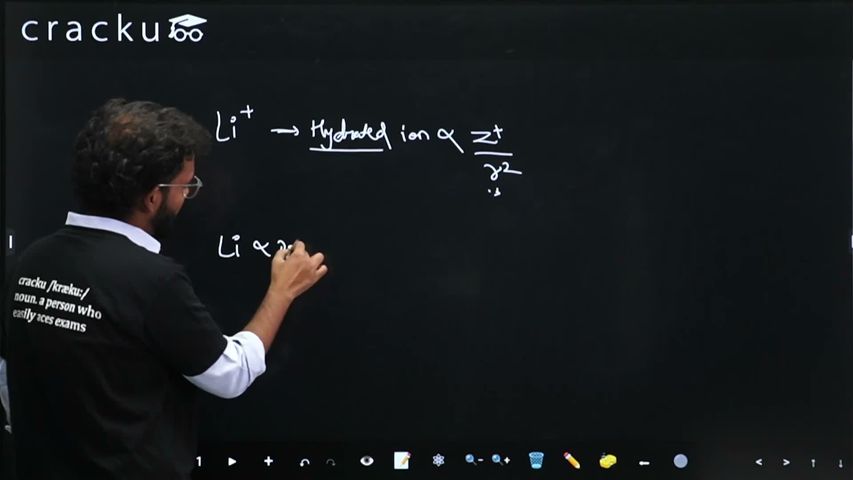
The lithium ion is $$\text{Li}^+$$. Its ionic radius $$r_{\text{Li}^+}$$ is the smallest in the entire alkali-metal group. Hydration depends upon the interaction between an ion and water dipoles, and the energy released is called hydration enthalpy $$\Delta H_{\text{hyd}}$$. A standard qualitative rule is
$$\Delta H_{\text{hyd}}\propto \dfrac{z^{+}}{r^{2}}$$
where $$z^{+}$$ is the charge on the cation and $$r$$ is its radius. Because $$r_{\text{Li}^+}$$ is minimum while $$z^{+}=1$$ for all alkali-metal ions, the term $$\dfrac{z^{+}}{r^{2}}$$ is maximum for $$\text{Li}^+$$. Hence $$\Delta H_{\text{hyd}}(\text{Li}^+)$$ is largest, water molecules are strongly attracted, and solid lithium salts often crystallise with molecules of water, i.e. they are hydrated. So the Assertion is correct.
Now consider the Reason (R): “Lithium has higher polarising power than other alkali metal group members.”
Polarising power is the ability of a cation to distort the electron cloud of an anion. The classical expression is
$$\text{Polarising power}\propto\dfrac{z^{+}}{r^{2}}$$
The numerator $$z^{+}$$ again equals 1 for all these monovalent cations, while the denominator $$r^{2}$$ is smallest for $$\text{Li}^+$$. Therefore $$\dfrac{1}{r^{2}}$$ is largest for lithium, making its polarising power the greatest among the alkali metals. Hence the Reason is also correct.
We must now decide whether the Reason truly explains the Assertion. Hydration stems from strong ion-dipole attraction, quantified by hydration enthalpy, which again involves the same $$\dfrac{z^{+}}{r^{2}}$$ factor. Polarising power, however, describes distortion of an anion’s electron cloud and leads chiefly to increased covalent character of the salt (e.g. LiI is more covalent than KI). While both high hydration enthalpy and high polarising power arise from the small size of $$\text{Li}^+$$, polarising power itself is not the direct cause of water of crystallisation. In other words, the Reason is a correct statement in its own right but it does not logically account for why lithium salts are hydrated.
Therefore, both (A) and (R) are correct, yet (R) is not the correct explanation of (A).
Hence, the correct answer is Option C.
Was this solution helpful?
Click on the Email ☝️ to Watch the Video Solution
Create a FREE account and get:
_1.webp)

Educational materials for JEE preparation

Ask our AI anything

AI can make mistakes. Please verify important information.
AI can make mistakes. Please verify important information.
