
Join Our JEE Preparation Group
Prep with like-minded aspirants; Get access to free daily tests and study material.
Sign in
Please select an account to continue using cracku.in
↓ →
Join Our JEE Preparation Group
Prep with like-minded aspirants; Get access to free daily tests and study material.
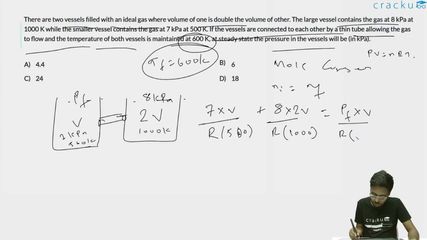
There are two vessels filled with an ideal gas where volume of one is double the volume of other. The large vessel contains the gas at 8 kPa at 1000 K while the smaller vessel contains the gas at 7 kPa at 500 K. If the vessels are connected to each other by a thin tube allowing the gas to flow and the temperature of both vessels is maintained at 600 K, at steady state the pressure in the vessels will be (in kPa).
Let the volume of the smaller vessel be $$V$$. The larger vessel has double this volume, so its volume is $$2V$$.
Initial data
Large vessel : $$P_1 = 8\text{ kPa},\; T_1 = 1000\text{ K},\; V_1 = 2V$$
Small vessel : $$P_2 = 7\text{ kPa},\; T_2 = 500\text{ K},\; V_2 = V$$
Using the ideal-gas equation $$PV = nRT$$, the initial number of moles in each vessel is
$$n_{1i} = \frac{P_1 V_1}{R T_1} = \frac{8 \times 2V}{R \times 1000} = \frac{16V}{1000R} = 0.016\frac{V}{R}$$
$$n_{2i} = \frac{P_2 V_2}{R T_2} = \frac{7 \times V}{R \times 500} = \frac{7V}{500R} = 0.014\frac{V}{R}$$
Total moles before connection
$$n_{\text{total}} = n_{1i} + n_{2i} = 0.016\frac{V}{R} + 0.014\frac{V}{R} = 0.030\frac{V}{R}$$
After connecting the vessels, both are maintained at a common temperature $$T_f = 600\text{ K}$$. At steady state the common pressure is $$P_f$$.
Moles in the large vessel at this stage:
$$n_{1f} = \frac{P_f \, V_1}{R T_f} = \frac{P_f \times 2V}{R \times 600} = \frac{P_f V}{300R}$$
Moles in the small vessel:
$$n_{2f} = \frac{P_f \, V_2}{R T_f} = \frac{P_f \times V}{R \times 600} = \frac{P_f V}{600R}$$
Total moles remain unchanged, so
$$n_{1f} + n_{2f} = n_{\text{total}}$$
$$\frac{P_f V}{300R} + \frac{P_f V}{600R} = 0.030\frac{V}{R}$$
Combine the terms on the left:
$$P_f V \left(\frac{1}{300} + \frac{1}{600}\right)\!\bigg/\!R = P_f V \left(\frac{2 + 1}{600}\right)\!\bigg/\!R = \frac{P_f V}{200R}$$
Equate this to the right side and solve for $$P_f$$:
$$\frac{P_f V}{200R} = 0.030\frac{V}{R} \;\;\Longrightarrow\;\; P_f = 0.030 \times 200 = 6\text{ kPa}$$
Hence the common steady-state pressure in both vessels is $$6\text{ kPa}$$.
Option B is correct.
Was this solution helpful?
Click on the Email ☝️ to Watch the Video Solution
Create a FREE account and get:
_1.webp)

Educational materials for JEE preparation

Ask our AI anything

AI can make mistakes. Please verify important information.
AI can make mistakes. Please verify important information.
