
Join Our JEE Preparation Group
Prep with like-minded aspirants; Get access to free daily tests and study material.
Sign in
Please select an account to continue using cracku.in
↓ →
Join Our JEE Preparation Group
Prep with like-minded aspirants; Get access to free daily tests and study material.
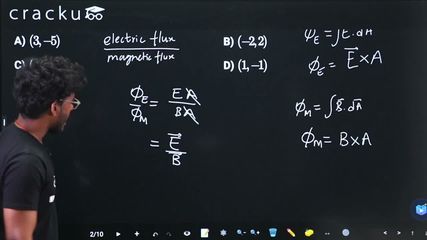
In an electromagnetic system, the quantity representing the ratio of electric flux and magnetic flux has dimension of $$M^P L^Q T^R A^S$$, where value of 'Q' and 'R' are
The required physical quantity is the ratio of electric flux $$\Phi_E$$ to magnetic flux $$\Phi_B$$. We must find the dimensions of each flux, then divide them.
Electric flux
Electric field $$E$$ is force per unit charge.
Force has dimensions $$MLT^{-2}$$, and charge has dimensions $$AT$$. Therefore,
$$E : \; \frac{MLT^{-2}}{AT}=MLT^{-3}A^{-1}$$
Electric flux is $$\Phi_E = E \times \text{area}$$, and area has dimension $$L^{2}$$. Thus
$$\Phi_E : \; (MLT^{-3}A^{-1})(L^{2}) = ML^{3}T^{-3}A^{-1}$$
Magnetic flux
Magnetic induction $$B$$ is obtained from $$F = qvB$$, giving $$B = F/(qv)$$.
$$B : \; \frac{MLT^{-2}}{(AT)(LT^{-1})}=MT^{-2}A^{-1}$$
Magnetic flux is $$\Phi_B = B \times \text{area}$$, so
$$\Phi_B : \; (MT^{-2}A^{-1})(L^{2}) = ML^{2}T^{-2}A^{-1}$$
Ratio of the two fluxes
$$\frac{\Phi_E}{\Phi_B} : \; \frac{ML^{3}T^{-3}A^{-1}}{ML^{2}T^{-2}A^{-1}}
= L^{3-2}\,T^{-3-(-2)}\,A^{-1-(-1)} = L^{1}T^{-1}$$
Hence the dimensional formula is $$M^{0}L^{1}T^{-1}A^{0}$$, giving
$$P = 0,\; Q = 1,\; R = -1,\; S = 0$$
Therefore, $$Q = 1$$ and $$R = -1$$, which corresponds to Option D.
Was this solution helpful?
Click on the Email ☝️ to Watch the Video Solution
Create a FREE account and get:
_1.webp)

Educational materials for JEE preparation

Ask our AI anything

AI can make mistakes. Please verify important information.
AI can make mistakes. Please verify important information.
