
Join Our JEE Preparation Group
Prep with like-minded aspirants; Get access to free daily tests and study material.
Sign in
Please select an account to continue using cracku.in
↓ →
Join Our JEE Preparation Group
Prep with like-minded aspirants; Get access to free daily tests and study material.
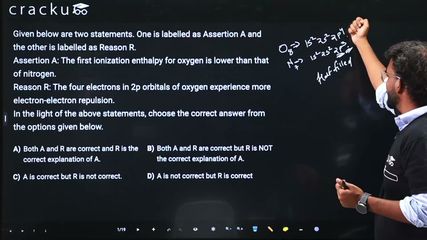
Given below are two statements. One is labelled as Assertion A and the other is labelled as Reason R.
Assertion A: The first ionization enthalpy for oxygen is lower than that of nitrogen.
Reason R: The four electrons in 2p orbitals of oxygen experience more electron-electron repulsion.
In the light of the above statements, choose the correct answer from the options given below.
We need to evaluate the Assertion-Reason statement about ionization enthalpies of oxygen and nitrogen. The first ionization enthalpy of oxygen (1314 kJ/mol) is indeed lower than that of nitrogen (1402 kJ/mol), which is a well-known exception in the periodic trend; thus Assertion A is correct.
Nitrogen has the electronic configuration 1s² 2s² 2p³, corresponding to half-filled 2p orbitals that confer extra stability, whereas oxygen has 1s² 2s² 2p⁴. In oxygen, the fourth electron in the 2p subshell must pair with one of the existing electrons, leading to increased electron-electron repulsion. This makes it easier to remove an electron from oxygen compared to nitrogen; therefore, Reason R is correct.
The reason directly explains why oxygen has a lower ionization enthalpy—the extra electron-electron repulsion due to pairing in the 2p orbital makes the electron easier to remove. Hence, R is the correct explanation of A.
Option A: Both A and R are correct and R is the correct explanation of A.
Was this solution helpful?
Click on the Email ☝️ to Watch the Video Solution
Create a FREE account and get:
_1.webp)

Educational materials for JEE preparation

Ask our AI anything

AI can make mistakes. Please verify important information.
AI can make mistakes. Please verify important information.
