
Join Our JEE Preparation Group
Prep with like-minded aspirants; Get access to free daily tests and study material.
Sign in
Please select an account to continue using cracku.in
↓ →
Join Our JEE Preparation Group
Prep with like-minded aspirants; Get access to free daily tests and study material.
An electron projected perpendicular to a uniform magnetic field B moves in a circle. If Bohr's quantization is applicable, then the radius of the electronic orbit in the first excited state is :
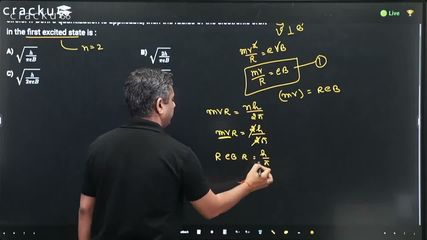
When an electron is projected perpendicular to a uniform magnetic field $$B$$, it moves in a circular path due to the magnetic force acting as the centripetal force. The force balance equation is given by:
$$ e v B = \frac{m v^2}{r} $$
where $$e$$ is the charge of the electron, $$v$$ is its speed, $$m$$ is its mass, and $$r$$ is the radius of the circular path. Simplifying this equation:
$$ e B = \frac{m v}{r} $$
Rearranging, we get:
$$ m v = e B r \quad \text{(1)} $$
Bohr's quantization condition states that the angular momentum is quantized and given by:
$$ m v r = n \frac{h}{2\pi} \quad \text{(2)} $$
where $$n$$ is the principal quantum number and $$h$$ is Planck's constant. The first excited state corresponds to $$n = 2$$ (since the ground state is $$n = 1$$). Substituting $$n = 2$$ into equation (2):
$$ m v r = 2 \times \frac{h}{2\pi} = \frac{h}{\pi} \quad \text{(3)} $$
We now have two equations: equation (1) $$m v = e B r$$ and equation (3) $$m v r = \frac{h}{\pi}$$. Substituting equation (1) into equation (3):
$$ (e B r) \times r = \frac{h}{\pi} $$
Simplifying:
$$ e B r^2 = \frac{h}{\pi} $$
Solving for $$r^2$$:
$$ r^2 = \frac{h}{\pi e B} $$
Taking the square root of both sides:
$$ r = \sqrt{\frac{h}{\pi e B}} $$
This is the radius of the electronic orbit in the first excited state. Comparing with the given options, this expression matches option A, $$\sqrt{\frac{h}{\pi eeB}}$$, when interpreted as $$\sqrt{\frac{h}{\pi e B}}$$ (considering "ee" as a typographical error for "e").
Thus, the correct option is A.
Was this solution helpful?
Click on the Email ☝️ to Watch the Video Solution
Create a FREE account and get:
_1.webp)

Educational materials for JEE preparation

Ask our AI anything

AI can make mistakes. Please verify important information.
AI can make mistakes. Please verify important information.
