
Join Our JEE Preparation Group
Prep with like-minded aspirants; Get access to free daily tests and study material.
Sign in
Please select an account to continue using cracku.in
↓ →
Join Our JEE Preparation Group
Prep with like-minded aspirants; Get access to free daily tests and study material.
The radius of the second Bohr orbit, in terms of the Bohr radius, $$a_0$$, in Li$$^{2+}$$ is:
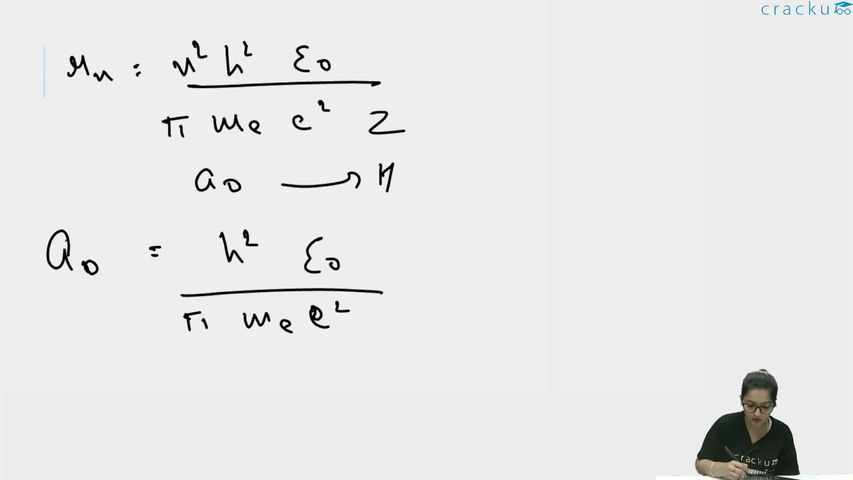
For any one-electron species, Bohr’s model gives the radius of the $$n^{\text{th}}$$ orbit as
$$r_n=\frac{n^2h^2\varepsilon_0}{\pi m_e e^2Z}.$$
In hydrogen, where $$Z=1$$ and $$n=1$$, this radius is called the Bohr radius $$a_0$$, so we write
$$a_0=\frac{h^2\varepsilon_0}{\pi m_e e^2}.$$
Dividing the two expressions term by term, the constant factors cancel, and we obtain the general relation
$$r_n=\frac{n^2a_0}{Z}.$$
For the doubly-ionised lithium ion, $$\text{Li}^{2+}$$, the nuclear charge is $$Z=3$$ because the nucleus has three protons. The question asks for the radius of the second Bohr orbit, so we put $$n=2$$. Substituting these values into the formula just derived gives
$$r_2=\frac{(2)^2a_0}{3}=\frac{4a_0}{3}.$$
This matches Option C.
Hence, the correct answer is Option C.
Was this solution helpful?
Click on the Email ☝️ to Watch the Video Solution
Create a FREE account and get:
_1.webp)

Educational materials for JEE preparation

Ask our AI anything

AI can make mistakes. Please verify important information.
AI can make mistakes. Please verify important information.


