
Join Our JEE Preparation Group
Prep with like-minded aspirants; Get access to free daily tests and study material.
Sign in
Please select an account to continue using cracku.in
↓ →
Join Our JEE Preparation Group
Prep with like-minded aspirants; Get access to free daily tests and study material.
The de Broglie wavelength $$(\lambda)$$ associated with a photoelectron varies with the frequency $$(\nu)$$ of the incident radiation as, [$$\nu_0$$ is threshold frequency]:
We start with Einstein’s photoelectric equation, which relates the energy of the incident photon to the work function and the kinetic energy of the emitted photo-electron:
$$h\nu \;=\; h\nu_0 \;+\; \dfrac12\,m\,v^2$$
Here $$h$$ is Planck’s constant, $$\nu$$ is the frequency of the incident radiation, $$\nu_0$$ is the threshold frequency of the metal, $$m$$ is the mass of the electron and $$v$$ is the speed of the ejected photo-electron.
First we isolate the kinetic energy term:
$$\dfrac12\,m\,v^2 \;=\; h\nu \;-\; h\nu_0$$
Now we solve for $$v^2$$ by multiplying both sides by $$\dfrac{2}{m}$$:
$$v^2 \;=\; \dfrac{2}{m}\,\bigl(h\nu \;-\; h\nu_0\bigr)$$
Taking the square root on both sides gives the speed $$v$$:
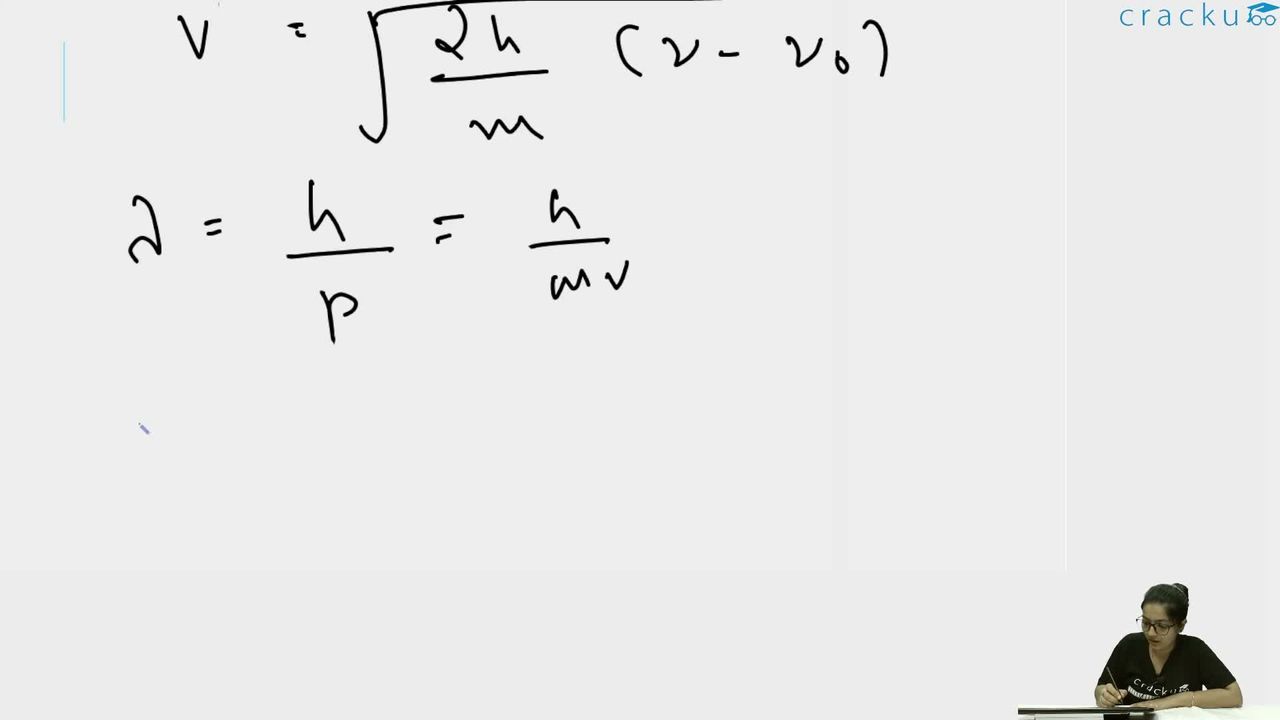
$$v \;=\; \sqrt{\dfrac{2}{m}\,\bigl(h\nu \;-\; h\nu_0\bigr)}$$
Next, we recall the de Broglie wavelength formula, which connects a particle’s momentum to its wavelength:
$$\lambda \;=\; \dfrac{h}{p}, \quad\text{where } p = m v$$
Substituting $$p = m v$$ into the formula gives:
$$\lambda \;=\; \dfrac{h}{m v}$$
Now we substitute the expression we have just obtained for $$v$$:
$$\lambda \;=\; \dfrac{h}{m}\;\dfrac{1}{\sqrt{\dfrac{2}{m}\,\bigl(h\nu \;-\; h\nu_0\bigr)}}$$
We rewrite the denominator clearly, keeping the square root intact:
$$\lambda \;=\; \dfrac{h}{m}\;\dfrac{1}{\sqrt{\dfrac{2h}{m}\,(\nu - \nu_0)}}$$
Since $$\dfrac{h}{m}$$ is a constant for the electron, we can collect all the constants together. Inside the square root, both $$2h$$ and $$m$$ are constants as well. Hence, after grouping constants, the wavelength can be seen to have the form
$$\lambda \;=\; \dfrac{\text{constant}}{\sqrt{\nu - \nu_0}}$$
Therefore, the de Broglie wavelength is inversely proportional to the square root of $$\nu - \nu_0$$:
$$\boxed{\lambda \;\propto\; \dfrac{1}{(\nu - \nu_0)^{1/2}}}$$
Among the given choices, this dependence corresponds to Option D.
Hence, the correct answer is Option D.
Was this solution helpful?
Click on the Email ☝️ to Watch the Video Solution
Create a FREE account and get:
_1.webp)

Educational materials for JEE preparation

Ask our AI anything

AI can make mistakes. Please verify important information.
AI can make mistakes. Please verify important information.


