
Join Our JEE Preparation Group
Prep with like-minded aspirants; Get access to free daily tests and study material.
Sign in
Please select an account to continue using cracku.in
↓ →
Join Our JEE Preparation Group
Prep with like-minded aspirants; Get access to free daily tests and study material.
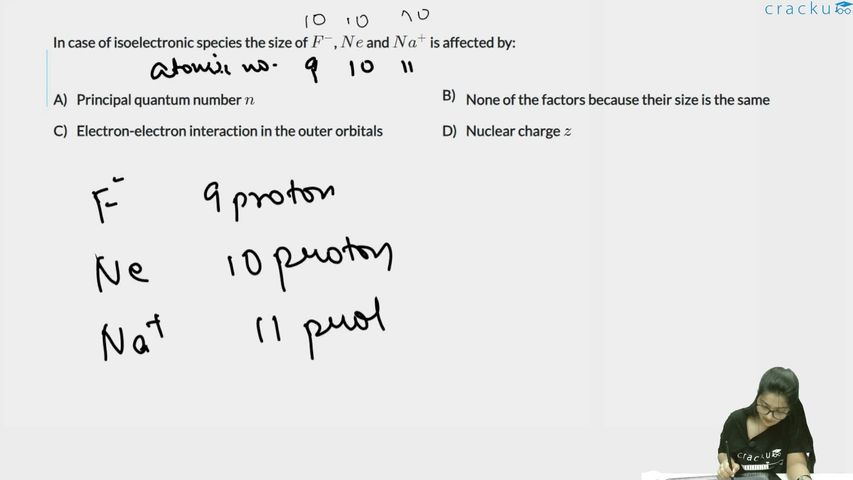
In case of isoelectronic species the size of $$F^-$$, $$Ne$$ and $$Na^+$$ is affected by:
In isoelectronic species $$F^-$$, $$Ne$$, and $$Na^+$$, all three have 10 electrons, corresponding to the electron configuration 1s$$^2$$ 2s$$^2$$ 2p$$^6$$. They therefore share the same principal quantum number $$n = 2$$ for their outermost electrons and experience identical electron-electron repulsion.
Their distinguishing feature is the nuclear charge $$Z$$: $$Z_{F^-} = 9$$, $$Z_{Ne} = 10$$, and $$Z_{Na^+} = 11$$. A higher nuclear charge pulls the same number of electrons closer to the nucleus, reducing the ionic or atomic radius.
Consequently, $$F^-$$ (Z = 9) has the weakest attraction and the largest size, $$Ne$$ (Z = 10) is intermediate, and $$Na^+$$ (Z = 11) has the strongest attraction and the smallest size, giving the order: $$F^- > Ne > Na^+$$.
The factor that affects the size of these isoelectronic species is the nuclear charge $$Z$$. The correct answer is Option D: Nuclear charge $$Z$$.
Was this solution helpful?
Click on the Email ☝️ to Watch the Video Solution
Create a FREE account and get:
_1.webp)

Educational materials for JEE preparation

Ask our AI anything

AI can make mistakes. Please verify important information.
AI can make mistakes. Please verify important information.
