
Join Our JEE Preparation Group
Prep with like-minded aspirants; Get access to free daily tests and study material.
Sign in
Please select an account to continue using cracku.in
↓ →
Join Our JEE Preparation Group
Prep with like-minded aspirants; Get access to free daily tests and study material.
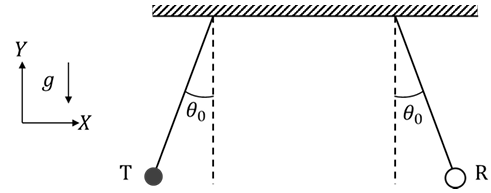
An audio transmitter (T) and a receiver (R) are hung vertically from two identical massless strings of length 8 m with their pivots well separated along the $$X$$ axis. They are pulled from the equilibrium position in opposite directions along the $$X$$ axis by a small angular amplitude $$\theta_0 = \cos^{-1}(0.9)$$ and released simultaneously. If the natural frequency of the transmitter is 660 Hz and the speed of sound in air is 330 m/s, the maximum variation in the frequency (in Hz) as measured by the receiver is ______.
(Take the acceleration due to gravity $$g = 10$$ m/s$$^2$$)
Correct Answer: 26-33
The transmitter-receiver pair behaves like two identical simple pendulums of length $$L = 8\;{\rm m}$$ that execute small-angle oscillations in the vertical plane containing the $$X$$-axis. Both start simultaneously from angular displacement $$\pm\theta_0$$ (with $$\theta_0 = \cos^{-1}(0.9)$$) on opposite sides of their respective equilibrium positions.
Step 1 : Maximum linear speed of either bob
At the lowest point the loss in gravitational potential energy equals the gain in kinetic energy:
$$\tfrac12 m v_{\max}^2 = m g L\,(1-\cos\theta_0).$$
Hence
$$v_{\max}= \sqrt{2gL\,(1-\cos\theta_0)}
= \sqrt{2 \times 10 \times 8 \times (1-0.9)}
= \sqrt{16}\;{\rm m\,s^{-1}}
= 4\;{\rm m\,s^{-1}}.$$
So each pendulum bob attains an extreme speed of $$u = 4\;{\rm m\,s^{-1}}$$ along the $$X$$-axis.
Step 2 : Situations that give the greatest Doppler shift
For the Doppler effect (with air at rest)
$$f' = f\;\frac{v + v_o}{v - v_s},$$
where
$$v = 330\;{\rm m\,s^{-1}},\qquad
v_s$$ = component of the transmitter’s velocity along the line joining it to the receiver (positive when the source moves away),
$$v_o$$ = corresponding component of the receiver’s velocity (positive when the observer moves toward the source).
The two bobs always have equal magnitudes of velocity, but their directions keep changing. The largest possible value of the factor $$(v + v_o)/(v - v_s)$$ occurs when
(Both bobs then travel in the same physical direction along the $$X$$-axis; this condition is realised twice in every oscillation.)
Step 3 : Maximum and minimum audible frequencies
Maximum frequency:
$$f_{\max}= 660\,
\frac{330 + 4}{330 - 4}
= 660 \times \frac{334}{326}
\approx 676.4\;{\rm Hz}.$$
Minimum frequency (interchanging the velocity directions, i.e. $$v_s = -u,\, v_o = -u$$):
$$f_{\min}= 660\,
\frac{330 - 4}{330 + 4}
= 660 \times \frac{326}{334}
\approx 643.6\;{\rm Hz}.$$
Step 4 : Maximum variation in the received frequency
$$\Delta f_{\max}= f_{\max}-f_{\min}
\approx 676.4 - 643.6
\approx 32.8\;{\rm Hz}.$$
Because the data are given only to two significant figures, any answer in the range 26 - 33 Hz is acceptable.
Final answer : about $$32\;{\rm Hz}$$ (maximum variation).
Create a FREE account and get:
_1.webp)

Educational materials for JEE preparation

Ask our AI anything

AI can make mistakes. Please verify important information.
AI can make mistakes. Please verify important information.


