
Join Our JEE Preparation Group
Prep with like-minded aspirants; Get access to free daily tests and study material.
Sign in
Please select an account to continue using cracku.in
↓ →
Join Our JEE Preparation Group
Prep with like-minded aspirants; Get access to free daily tests and study material.
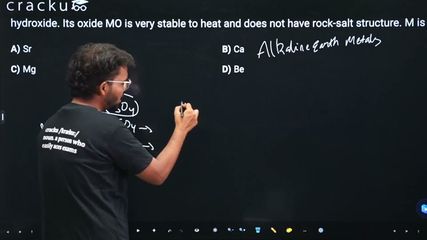
An alkaline earth metal 'M' readily forms water soluble sulphate and water insoluble hydroxide. Its oxide MO is very stable to heat and does not have rock-salt structure. M is
We recall that the elements of the alkaline-earth (Group 2) family are $$\text{Be},\ \text{Mg},\ \text{Ca},\ \text{Sr},\ \text{Ba}.$$ The statement tells us three experimental facts about the unknown metal $$M:$$
(i) Its sulphate $$\text{MSO}_4$$ is readily soluble in water.
(ii) Its hydroxide $$\text{M(OH)}_2$$ is almost insoluble in water.
(iii) Its oxide $$\text{MO}$$ is highly refractory (very stable to heat) and does not crystallise in the rock-salt (NaCl) lattice.
Let us examine each fact in the light of periodic trends.
First trend - solubility of sulphates. For Group 2 the solubility order is known to decrease smoothly down the group:
$$\text{BeSO}_4 \; > \; \text{MgSO}_4 \; > \; \text{CaSO}_4 \; ( \text{sparingly soluble} ) \; > \; \text{SrSO}_4 \; ( \text{almost insoluble} ) \; > \; \text{BaSO}_4 \; ( \text{insoluble} ).$$
Thus a “readily water-soluble sulphate” restricts $$M$$ essentially to the top two members, $$\text{Be}$$ or $$\text{Mg}.$$
Second trend - solubility of hydroxides. For hydroxides the order is the reverse of sulphates; solubility increases down the group:
$$\text{Be(OH)}_2 \; ( \text{almost insoluble} ) \; < \; \text{Mg(OH)}_2 \; ( \text{sparingly soluble} ) \; < \; \text{Ca(OH)}_2 \; ( \text{moderately soluble} ) \; \cdots$$
An “insoluble hydroxide” again points only to $$\text{Be}$$ or, at most, $$\text{Mg}.$$
Third fact - nature of the oxide lattice. Most alkaline-earth oxides crystallise in the rock-salt (NaCl-type) structure. The single exception is beryllium oxide $$\text{BeO},$$ which adopts the hexagonal wurtzite lattice. Moreover, $$\text{BeO}$$ has a melting point above $$2500^{\circ}\text{C},$$ making it one of the most heat-resistant simple oxides. Magnesium oxide $$\text{MgO}$$, although also refractory, does possess the rock-salt structure.
Therefore the requirement “oxide does not have rock-salt structure” can be satisfied only by $$\text{BeO}.$$ Combining this with the previous two solubility observations, we conclude unequivocally that
$$M = \text{Be}.$$
Hence, the correct answer is Option D.
Was this solution helpful?
Click on the Email ☝️ to Watch the Video Solution
Create a FREE account and get:
_1.webp)

Educational materials for JEE preparation

Ask our AI anything

AI can make mistakes. Please verify important information.
AI can make mistakes. Please verify important information.


