
Join Our JEE Preparation Group
Prep with like-minded aspirants; Get access to free daily tests and study material.
Sign in
Please select an account to continue using cracku.in
↓ →
Join Our JEE Preparation Group
Prep with like-minded aspirants; Get access to free daily tests and study material.
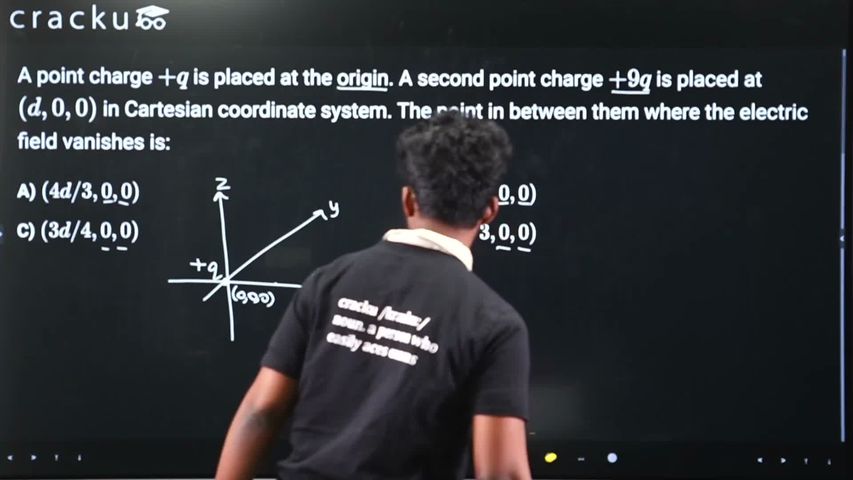
A point charge $$+q$$ is placed at the origin. A second point charge $$+9q$$ is placed at $$(d, 0, 0)$$ in Cartesian coordinate system. The point in between them where the electric field vanishes is:
Let the first charge $$+q$$ be at the origin $$O(0,0,0)$$ and the second charge $$+9q$$ be at $$P(d,0,0)$$ on the x-axis.
Because both charges are positive, the electric field produced by each charge at any point on the line joining them points away from the respective charge.
Hence, at a point in between the two charges the field contributions will be in opposite directions and can cancel out.
Assume the required point $$R$$ is at $$x$$ (with $$0 \lt x \lt d$$).
Position of $$R$$: $$(x,0,0)$$.
Magnitude of field at $$R$$ due to $$+q$$ at the origin:
$$E_1 = \frac{kq}{x^{2}}$$ directed along $$+\hat{i}$$.
Magnitude of field at $$R$$ due to $$+9q$$ at $$P(d,0,0)$$:
$$E_2 = \frac{k(9q)}{(d-x)^{2}}$$ directed along $$-\hat{i}$$ (to the left).
For the net field to vanish, the magnitudes must be equal:
$$E_1 = E_2 \Longrightarrow \frac{kq}{x^{2}} = \frac{k(9q)}{(d-x)^{2}}$$.
Cancelling the common factors $$kq$$ gives
$$\frac{1}{x^{2}} = \frac{9}{(d-x)^{2}}$$.
Taking square roots:
$$\frac{1}{x} = \frac{3}{d-x} \Longrightarrow d - x = 3x$$.
Solving for $$x$$:
$$d = 4x \Longrightarrow x = \frac{d}{4}$$.
Therefore the electric field is zero at the point $$(d/4, 0, 0)$$.
Hence, the correct option is Option B.
Was this solution helpful?
Click on the Email ☝️ to Watch the Video Solution
Create a FREE account and get:
_1.webp)

Educational materials for JEE preparation

Ask our AI anything

AI can make mistakes. Please verify important information.
AI can make mistakes. Please verify important information.


