
Join Our JEE Preparation Group
Prep with like-minded aspirants; Get access to free daily tests and study material.
Sign in
Please select an account to continue using cracku.in
↓ →
Join Our JEE Preparation Group
Prep with like-minded aspirants; Get access to free daily tests and study material.
Two elements A and B have similar chemical properties. They don't form solid hydrogencarbonates, but react with nitrogen to form nitrides. A and B, respectively, are:
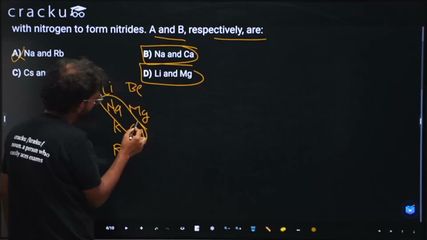
We begin by recalling a basic periodic-table idea known as the diagonal relationship. According to this concept, the first element of a period in the $$s$$-block often shows properties similar to the second element of the next period lying diagonally below it. Thus, $$\text{Li (Group 1, Period 2)}$$ is diagonally related to $$\text{Mg (Group 2, Period 3)}$$ and they exhibit many chemical similarities.
Now let us match the two special properties mentioned in the question with the behaviour of different $$s$$-block elements:
1. They do not form solid hydrogencarbonates.
• For most alkali metals, a salt such as $$\text{NaHCO}_{3}$$ or $$\text{KHCO}_{3}$$ can be isolated in the solid state.
• However, $$\text{LiHCO}_{3}$$ is not stable as a solid. When an attempt is made to isolate it, it decomposes: $$\text{2 LiHCO}_{3 \,(aq)} \;\longrightarrow\; \text{Li}_{2}\text{CO}_{3 \,(s)} + \text{CO}_{2} + \text{H}_{2}\text{O}.$$
• A very similar situation exists for magnesium. The salt $$\text{Mg(HCO}_{3})_{2}$$ only survives in aqueous solution; on heating or isolation it converts to $$\text{MgCO}_{3}$$, releasing $$\text{CO}_{2}$$ and water.
2. They react with nitrogen to give nitrides.
• Lithium burns in nitrogen to give the nitride $$\text{Li}_{3}\text{N}$$: $$6\text{Li} + \text{N}_{2} \rightarrow 2\text{Li}_{3}\text{N}.$$
• Magnesium also combines directly with nitrogen to form $$\text{Mg}_{3}\text{N}_{2}$$: $$3\text{Mg} + \text{N}_{2} \rightarrow \text{Mg}_{3}\text{N}_{2}.$$
Both of these characteristic reactions are uncommon for the heavier alkali metals such as Na, K, Rb, Cs and for the heavier alkaline-earth metals like Ca, Sr, Ba. Thus, if two elements satisfy both conditions simultaneously, the only reasonable pair from the options is lithium and magnesium.
Let us quickly check the other options one by one:
• $$\text{Na}$$ and $$\text{Rb}$$ (Option A): sodium makes solid $$\text{NaHCO}_{3}$$ and rubidium makes solid $$\text{RbHCO}_{3}$$, so this pair is ruled out.
• $$\text{Na}$$ and $$\text{Ca}$$ (Option B): sodium again forms a solid hydrogencarbonate; calcium forms solid $$\text{Ca(HCO}_{3})_{2}$$ solutions that can be crystallised as double salts, so the property is not matched.
• $$\text{Cs}$$ and $$\text{Ba}$$ (Option C): both form solid hydrogencarbonates under appropriate conditions; moreover they do not readily give stable binary nitrides in the same way Li and Mg do.
• $$\text{Li}$$ and $$\text{Mg}$$ (Option D): exactly fit the two conditions just verified.
Therefore, the pair A and B must be $$\text{Li}$$ and $$\text{Mg}$$.
Hence, the correct answer is Option D.
Was this solution helpful?
Click on the Email ☝️ to Watch the Video Solution
Create a FREE account and get:
_1.webp)

Educational materials for JEE preparation

Ask our AI anything

AI can make mistakes. Please verify important information.
AI can make mistakes. Please verify important information.


