
Join Our JEE Preparation Group
Prep with like-minded aspirants; Get access to free daily tests and study material.
Sign in
Please select an account to continue using cracku.in
↓ →
Join Our JEE Preparation Group
Prep with like-minded aspirants; Get access to free daily tests and study material.
Light is incident on a metallic plate having work function $$110 \times 10^{-20}J$$. If the produced photoelectrons have zero kinetic energy then the angular frequency of the incident light is ___ rad/s. (h = $$6.63 \times 10^{-34}J.s.$$).
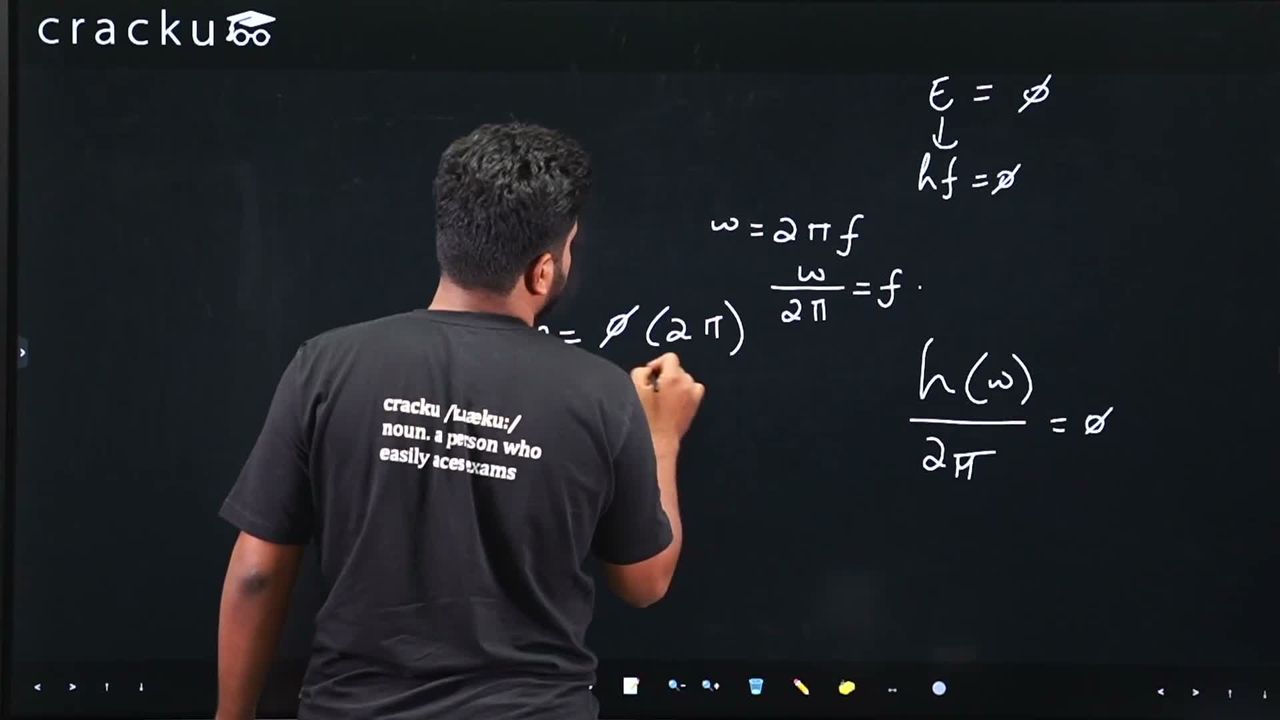
The work function of the material is $$\phi = 110 \times 10^{-20}$$ J, which can also be expressed as $$1.1 \times 10^{-18}$$ J, and since the photoelectrons are emitted with zero kinetic energy, the photon energy must exactly equal this work function. Taking Planck’s constant as $$h = 6.63 \times 10^{-34}$$ J·s, we write
$$E = \phi = \hbar\omega$$
with $$\hbar = \frac{h}{2\pi}$$ and $$\omega$$ being the angular frequency. Solving for $$\omega$$ gives
$$\omega = \frac{\phi}{\hbar} = \frac{2\pi\phi}{h} = \frac{2 \times 3.14 \times 1.1 \times 10^{-18}}{6.63 \times 10^{-34}} = \frac{6.908 \times 10^{-18}}{6.63 \times 10^{-34}} = 1.042 \times 10^{16} \text{ rad/s}$$
The correct answer is Option A: $$1.04 \times 10^{16}$$ rad/s.
Was this solution helpful?
Click on the Email ☝️ to Watch the Video Solution
Create a FREE account and get:
_1.webp)

Educational materials for JEE preparation

Ask our AI anything

AI can make mistakes. Please verify important information.
AI can make mistakes. Please verify important information.
