
Join Our JEE Preparation Group
Prep with like-minded aspirants; Get access to free daily tests and study material.
Sign in
Please select an account to continue using cracku.in
↓ →
Join Our JEE Preparation Group
Prep with like-minded aspirants; Get access to free daily tests and study material.
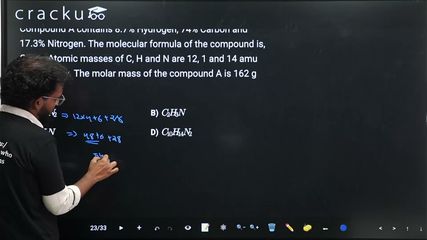
Compound A contains 8.7% Hydrogen, 74% Carbon and 17.3% Nitrogen. The molecular formula of the compound is, Given: Atomic masses of C, H and N are 12, 1 and 14 amu respectively. The molar mass of the compound A is 162 g mol$$^{-1}$$.
The composition of the compound is 8.7% hydrogen, 74% carbon, and 17.3% nitrogen, and its molar mass is 162 g/mol. We first calculate the mole ratio of each element:
$$\text{Moles of C} = \frac{74}{12} = 6.167$$
$$\text{Moles of H} = \frac{8.7}{1} = 8.7$$
$$\text{Moles of N} = \frac{17.3}{14} = 1.236$$
Dividing by the smallest value, 1.236, gives
$$\text{C} : \text{H} : \text{N} = \frac{6.167}{1.236} : \frac{8.7}{1.236} : \frac{1.236}{1.236}$$
$$= 4.99 : 7.04 : 1 \approx 5 : 7 : 1$$
Thus the empirical formula is $$C_5H_7N$$, and its formula mass is $$5 \times 12 + 7 \times 1 + 14 = 60 + 7 + 14 = 81$$ g/mol.
The multiplication factor is $$n = \frac{\text{Molar mass}}{\text{Empirical formula mass}} = \frac{162}{81} = 2$$.
Multiplying the subscripts in the empirical formula by 2 yields the molecular formula
$$ (\text{C}_5\text{H}_7\text{N})_2 = \text{C}_{10}\text{H}_{14}\text{N}_2$$
Hence, the correct answer is Option D ($$C_{10}H_{14}N_2$$).
Was this solution helpful?
Click on the Email ☝️ to Watch the Video Solution
Create a FREE account and get:
_1.webp)

Educational materials for JEE preparation

Ask our AI anything

AI can make mistakes. Please verify important information.
AI can make mistakes. Please verify important information.
