
Join Our JEE Preparation Group
Prep with like-minded aspirants; Get access to free daily tests and study material.
Sign in
Please select an account to continue using cracku.in
↓ →
Join Our JEE Preparation Group
Prep with like-minded aspirants; Get access to free daily tests and study material.
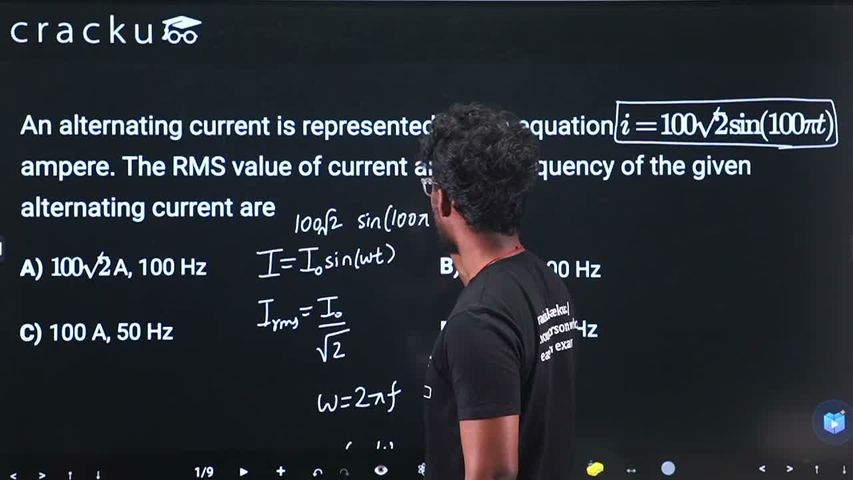
An alternating current is represented by the equation $$i = 100\sqrt{2} \sin(100\pi t)$$ ampere. The RMS value of current and the frequency of the given alternating current are
The instantaneous current of a sinusoidal a.c. source is generally written as$$i = I_0 \sin(\omega t)$$where
• $$I_0$$ is the peak (maximum) current.
• $$\omega$$ is the angular frequency related to the ordinary frequency $$f$$ by$$\omega = 2\pi f$$.
Comparing the given expression$$i = 100\sqrt{2}\,\sin(100\pi t)$$with$$i = I_0 \sin(\omega t)$$we identify
$$I_0 = 100\sqrt{2}\quad\text{and}\quad\omega = 100\pi\ \text{rad s}^{-1}$$.
Step 1: RMS (root-mean-square) value
For a pure sine wave, the RMS current is related to the peak current by$$I_{\text{rms}} = \frac{I_0}{\sqrt{2}}$$Applying this formula:
$$I_{\text{rms}} = \frac{100\sqrt{2}}{\sqrt{2}} = 100\ \text{A}$$.
Step 2: Frequency
Using the relation$$f = \frac{\omega}{2\pi}$$substitute $$\omega = 100\pi$$:
$$f = \frac{100\pi}{2\pi} = 50\ \text{Hz}$$.
Result
RMS current $$= 100\ \text{A}$$ and frequency $$= 50\ \text{Hz}$$.
These match Option C.
Was this solution helpful?
Click on the Email ☝️ to Watch the Video Solution
Create a FREE account and get:
_1.webp)

Educational materials for JEE preparation

Ask our AI anything

AI can make mistakes. Please verify important information.
AI can make mistakes. Please verify important information.
