
Join Our JEE Preparation Group
Prep with like-minded aspirants; Get access to free daily tests and study material.
Sign in
Please select an account to continue using cracku.in
↓ →
Join Our JEE Preparation Group
Prep with like-minded aspirants; Get access to free daily tests and study material.
The one division of main scale of Vernier callipers reads $$1 \text{ mm}$$ and $$10$$ divisions of Vernier scale is equal to the $$9$$ divisions on main scale. When the two jaws of the instrument touch each other the zero of the Vernier lies to the right of zero of the main scale and its fourth division coincides with a main scale division. When a spherical bob is tightly placed between the two jaws, the zero of the Vernier scale lies in between $$4.1 \text{ cm}$$ and $$4.2 \text{ cm}$$ and $$6^{th}$$ Vernier division coincides with a main scale division. The diameter of the bob will be ______ $$ 10^{-2} cm$$.
Correct Answer: 412
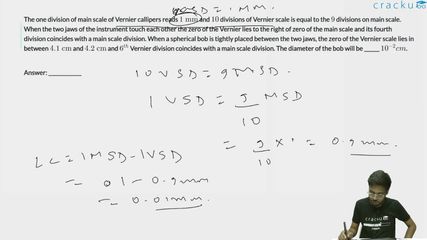
We are given a Vernier callipers where 1 main scale division (MSD) = $$1 \text{ mm}$$ and 10 Vernier scale divisions (VSD) = 9 MSD.
Since 1 VSD = $$\dfrac{9}{10}$$ MSD = 0.9 mm, the least count (LC) is the difference between one main scale division and one Vernier scale division:
$$\text{Least count (LC)} = 1 \text{ MSD} - 1 \text{ VSD} = 1 - 0.9 = 0.1 \text{ mm} = 0.01 \text{ cm}$$
When the jaws touch, the zero of the Vernier lies to the right of the zero of the main scale, and the 4th Vernier division coincides with a main scale division, indicating a positive zero error of
$$\text{Zero error} = +4 \t\times \text{LC} = +4 \t\times 0.01 = +0.04 \text{ cm}$$
In taking the measurement, the zero of the Vernier lies between $$4.1 \text{ cm}$$ and $$4.2 \text{ cm}$$ on the main scale, so the main scale reading (MSR) is:
$$\text{MSR} = 4.1 \text{ cm}$$
At the same time, the 6th Vernier division coincides with a main scale division, giving a Vernier scale reading of
$$\text{Vernier Scale Reading} = 6 \t\times \text{LC} = 6 \t\times 0.01 = 0.06 \text{ cm}$$
Therefore, the observed reading is the sum of MSR and VSR:
$$\text{Observed reading} = \text{MSR} + \text{VSR} = 4.1 + 0.06 = 4.16 \text{ cm}$$
Applying the zero correction by subtracting the zero error from the observed reading gives the correct reading:
$$\text{Correct reading} = \text{Observed reading} - \text{Zero error}$$
$$= 4.16 - 0.04 = 4.12 \text{ cm}$$
This result can be expressed in the required form as
$$4.12 \text{ cm} = 412 \t\times 10^{-2} \text{ cm}$$
The diameter of the bob is $$412 \t\times 10^{-2} \text{ cm}$$.
Was this solution helpful?
Click on the Email ☝️ to Watch the Video Solution
Create a FREE account and get:
_1.webp)

Educational materials for JEE preparation

Ask our AI anything

AI can make mistakes. Please verify important information.
AI can make mistakes. Please verify important information.
