
Join Our JEE Preparation Group
Prep with like-minded aspirants; Get access to free daily tests and study material.
Sign in
Please select an account to continue using cracku.in
↓ →
Join Our JEE Preparation Group
Prep with like-minded aspirants; Get access to free daily tests and study material.
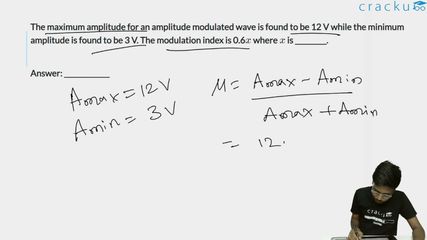
The maximum amplitude for an amplitude modulated wave is found to be 12 V while the minimum amplitude is found to be 3 V. The modulation index is 0.6$$x$$ where $$x$$ is _________.
Correct Answer: 1
For an amplitude modulated (AM) signal, the envelope shows a highest (maximum) value and a lowest (minimum) value of the instantaneous amplitude. The quantity that tells us how strongly the carrier is being modulated by the message is called the modulation index, usually denoted by $$m$$.
First we recall the standard formula that relates the modulation index $$m$$ to the maximum envelope voltage $$E_{\max}$$ and the minimum envelope voltage $$E_{\min}$$:
$$m \;=\; \dfrac{E_{\max}-E_{\min}}{E_{\max}+E_{\min}}.$$
This formula can be remembered as “difference over sum,” and it comes directly from writing the upper and lower envelopes of an AM wave as $$E_c(1+m)$$ and $$E_c(1-m)$$, where $$E_c$$ is the unmodulated carrier amplitude. Subtracting and adding those two expressions gives the above relation.
Now we substitute the numerical values given in the question. The maximum envelope voltage is $$E_{\max}=12\text{ V}$$ and the minimum envelope voltage is $$E_{\min}=3\text{ V}$$. Putting these into the formula gives
$$m \;=\; \dfrac{12\text{ V}-3\text{ V}}{12\text{ V}+3\text{ V}}.$$
Carrying out the subtraction in the numerator, we have
$$m \;=\; \dfrac{9\text{ V}}{12\text{ V}+3\text{ V}}.$$
Next we add the voltages in the denominator:
$$m \;=\; \dfrac{9\text{ V}}{15\text{ V}}.$$
Since both numerator and denominator carry the unit “volt,” the units cancel, leaving a pure number:
$$m \;=\; \dfrac{9}{15}.$$
To simplify the fraction, we divide both numerator and denominator by their highest common factor, which is 3:
$$m \;=\; \dfrac{9\div 3}{15\div 3} \;=\; \dfrac{3}{5}.$$
Writing the fraction $$\dfrac{3}{5}$$ in decimal form, we remember that $$\dfrac{3}{5}=0.6$$. Hence we have
$$m = 0.6.$$
The statement in the problem says that “the modulation index is $$0.6x$$.” We have just found that the modulation index equals $$0.6$$ itself. Therefore, comparing the two expressions,
$$0.6x = 0.6.$$
To get the value of $$x$$, we divide both sides of the equation by $$0.6$$:
$$x = \dfrac{0.6}{0.6} = 1.$$
So, the answer is $$1$$.
Was this solution helpful?
Click on the Email ☝️ to Watch the Video Solution
Create a FREE account and get:
_1.webp)

Educational materials for JEE preparation

Ask our AI anything

AI can make mistakes. Please verify important information.
AI can make mistakes. Please verify important information.
