
Join Our JEE Preparation Group
Prep with like-minded aspirants; Get access to free daily tests and study material.
Sign in
Please select an account to continue using cracku.in
↓ →
Join Our JEE Preparation Group
Prep with like-minded aspirants; Get access to free daily tests and study material.
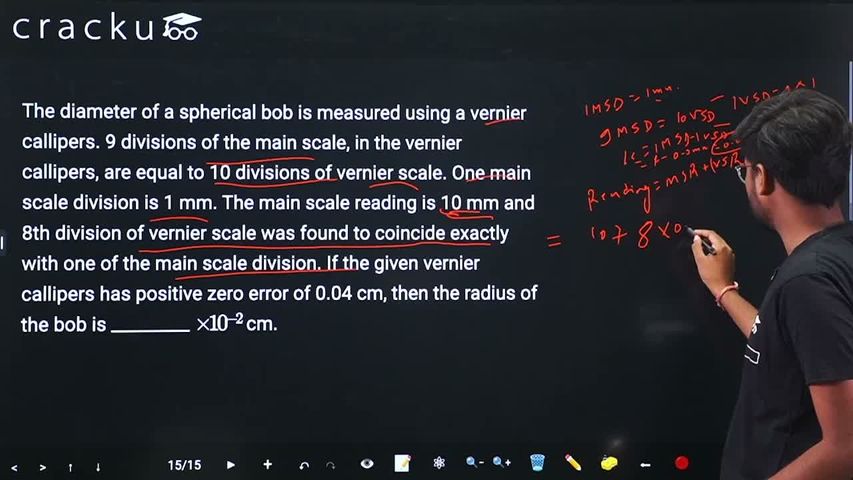
The diameter of a spherical bob is measured using a vernier callipers. 9 divisions of the main scale, in the vernier callipers, are equal to 10 divisions of vernier scale. One main scale division is 1 mm. The main scale reading is 10 mm and 8th division of vernier scale was found to coincide exactly with one of the main scale division. If the given vernier callipers has positive zero error of 0.04 cm, then the radius of the bob is _________ $$\times 10^{-2}$$ cm.
Correct Answer: 52
We have a vernier callipers in which 9 main-scale divisions are equal in length to 10 vernier-scale divisions. First we find the length of one vernier division. One main-scale division (MSD) is given to be $$1\ \text{mm}.$$ Therefore
$$ \text{Length of one vernier division (VSD)} = \frac{9\ \text{MSD}}{10} = \frac{9 \times 1\ \text{mm}}{10} = 0.9\ \text{mm}. $$
The least count (LC) of a vernier callipers is defined as
$$ \text{LC} = 1\ \text{MSD} - 1\ \text{VSD}. $$
Substituting the values, we get
$$ \text{LC} = 1\ \text{mm} - 0.9\ \text{mm} = 0.1\ \text{mm}. $$
Now we read the scale. The main-scale reading (MSR) given is $$10\ \text{mm}.$$ The 8th vernier division coincides with a main-scale division, so the vernier-scale reading (VSR) is obtained by multiplying the coincident division number with the least count:
$$ \text{VSR} = 8 \times \text{LC} = 8 \times 0.1\ \text{mm} = 0.8\ \text{mm}. $$
The measured diameter (before zero-error correction) is therefore
$$ d_{\text{meas}} = \text{MSR} + \text{VSR} = 10\ \text{mm} + 0.8\ \text{mm} = 10.8\ \text{mm}. $$
Writing this in centimetres, since $$10\ \text{mm} = 1\ \text{cm},$$ we have
$$ d_{\text{meas}} = 10.8\ \text{mm} = 1.08\ \text{cm}. $$
The instrument possesses a positive zero error of $$0.04\ \text{cm}.$$ For a positive zero error, the true reading is obtained by subtracting the zero error from the measured reading. Hence
$$ d_{\text{true}} = d_{\text{meas}} - (\text{zero error}) = 1.08\ \text{cm} - 0.04\ \text{cm} = 1.04\ \text{cm}. $$
The radius is half of the true diameter:
$$ r = \frac{d_{\text{true}}}{2} = \frac{1.04\ \text{cm}}{2} = 0.52\ \text{cm}. $$
Expressing $$0.52\ \text{cm}$$ in the form $$N \times 10^{-2}\ \text{cm}$$ gives
$$ 0.52\ \text{cm} = 52 \times 10^{-2}\ \text{cm}. $$
Hence, the answer is $$52.$$
Was this solution helpful?
Click on the Email ☝️ to Watch the Video Solution
Create a FREE account and get:
_1.webp)

Educational materials for JEE preparation

Ask our AI anything

AI can make mistakes. Please verify important information.
AI can make mistakes. Please verify important information.
