
Join Our JEE Preparation Group
Prep with like-minded aspirants; Get access to free daily tests and study material.
Sign in
Please select an account to continue using cracku.in
↓ →
Join Our JEE Preparation Group
Prep with like-minded aspirants; Get access to free daily tests and study material.
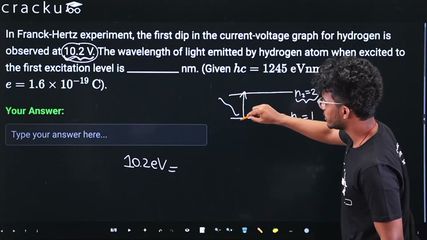
In Franck-Hertz experiment, the first dip in the current-voltage graph for hydrogen is observed at 10.2 V. The wavelength of light emitted by hydrogen atom when excited to the first excitation level is ___________ nm. (Given $$hc = 1245 \text{ eVnm}$$, $$e = 1.6 \times 10^{-19} \text{ C}$$).
Correct Answer: 122
We need to find the wavelength of light emitted when hydrogen is excited to the first excitation level (10.2 eV).
In the Franck-Hertz experiment, the first dip at 10.2 V corresponds to the energy required to excite hydrogen from the ground state $$n = 1$$ to the first excited state $$n = 2$$, and when the atom de-excites back to $$n = 1$$, it emits a photon with energy equal to 10.2 eV.
The energy-wavelength relationship for a photon is given by
$$E = \frac{hc}{\lambda} \implies \lambda = \frac{hc}{E}$$
First, the energy of the emitted photon is $$E = 10.2 \, \text{eV}$$.
Next, using the value $$hc = 1245 \, \text{eV·nm}$$, we find
$$\lambda = \frac{1245}{10.2} = 122.06 \approx 122 \, \text{nm}$$
This corresponds to the Lyman-alpha line of hydrogen (the $$n = 2 \to n = 1$$ transition), which lies in the ultraviolet region.
The correct answer is 122 nm.
Was this solution helpful?
Click on the Email ☝️ to Watch the Video Solution
Create a FREE account and get:
_1.webp)

Educational materials for JEE preparation

Ask our AI anything

AI can make mistakes. Please verify important information.
AI can make mistakes. Please verify important information.
