
Join Our JEE Preparation Group
Prep with like-minded aspirants; Get access to free daily tests and study material.
Sign in
Please select an account to continue using cracku.in
↓ →
Join Our JEE Preparation Group
Prep with like-minded aspirants; Get access to free daily tests and study material.
For a short dipole placed at origin O, the dipole moment is along x-axis, as shown in the figure. If the electric potential and electric field at A are $$V_{\circ}$$ and $$E_{\circ}$$, respectively, then the correct combination of the electric potential and electric field, respectively, at point B on the -axis is given by
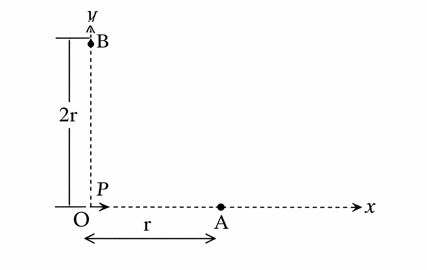
dipole is along +x direction.
point A is on the axial line at distance r
point B is on the equatorial line at distance 2r (on y-axis)
at A (axial point):
for a dipole,
V ∝ p cosθ / r²
here θ = 0° ⇒ cosθ = 1
so,
V₀ = (1/4πϵ₀)(p/r²)
electric field on axial line:
E₀ = (1/4πϵ₀)(2p/r³)
at B (equatorial point):
here θ = 90° ⇒ cosθ = 0
so potential:
V_B = 0
(this is because contributions from +q and −q cancel in potential)
electric field at equatorial point:
fields from +q and −q don’t cancel completely — their components add opposite to dipole moment direction
magnitude:
E_B = (1/4πϵ₀)(p/(distance)³)
distance = 2r
so:
E_B = (1/4πϵ₀)(p/(2r)³)
= (1/4πϵ₀)(p/8r³)
now compare with E₀:
E₀ = (1/4πϵ₀)(2p/r³)
so,
E_B / E₀ = (p/8r³) / (2p/r³) = 1/16
Was this solution helpful?
Create a FREE account and get:
_1.webp)

Educational materials for JEE preparation

Ask our AI anything

AI can make mistakes. Please verify important information.
AI can make mistakes. Please verify important information.
