
Join Our JEE Preparation Group
Prep with like-minded aspirants; Get access to free daily tests and study material.
Sign in
Please select an account to continue using cracku.in
↓ →
Join Our JEE Preparation Group
Prep with like-minded aspirants; Get access to free daily tests and study material.
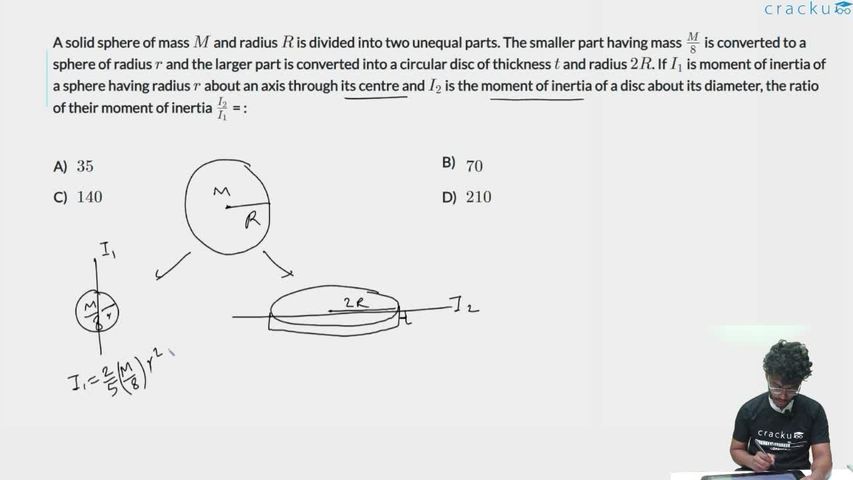
A solid sphere of mass $$M$$ and radius $$R$$ is divided into two unequal parts. The smaller part having mass $$\frac{M}{8}$$ is converted to a sphere of radius $$r$$ and the larger part is converted into a circular disc of thickness $$t$$ and radius $$2R$$. If $$I_1$$ is moment of inertia of a sphere having radius $$r$$ about an axis through its centre and $$I_2$$ is the moment of inertia of a disc about its diameter, the ratio of their moment of inertia $$\frac{I_2}{I_1}$$ = :
Let the original solid sphere have uniform density $$\rho$$. Hence
$$M=\rho \left(\frac{4}{3}\pi R^{3}\right) \qquad -(1)$$
Step 1: Determine the radius $$r$$ of the smaller sphere
The smaller part has mass $$\dfrac{M}{8}$$ and is recast into a solid sphere of radius $$r$$:
$$\frac{M}{8}= \rho \left(\frac{4}{3}\pi r^{3}\right) \qquad -(2)$$
Divide $$(2)$$ by $$(1)$$:
$$\frac{1}{8}= \frac{r^{3}}{R^{3}} \;\;\Longrightarrow\;\; r^{3}= \frac{R^{3}}{8} \;\;\Longrightarrow\;\; r=\frac{R}{2}$$
Step 2: Determine the thickness $$t$$ of the disc
The remaining mass $$\dfrac{7M}{8}$$ is cast into a uniform circular disc of radius $$2R$$ and thickness $$t$$.
Volume of the disc = $$\pi (2R)^{2}\,t = 4\pi R^{2}t$$, so
$$\frac{7M}{8}= \rho \bigl(4\pi R^{2}t\bigr) \qquad -(3)$$
Substitute $$M$$ from $$(1)$$ into $$(3)$$:
$$\frac{7}{8}\,\rho\!\left(\frac{4}{3}\pi R^{3}\right)= \rho \left(4\pi R^{2}t\right)$$
Cancel $$\rho\pi$$ and simplify:
$$\frac{7R^{3}}{6}=4R^{2}t \;\;\Longrightarrow\;\; t=\frac{7R}{24}$$
Step 3: Moment of inertia of the small sphere
For a solid sphere about any diameter, $$I=\dfrac{2}{5}mr^{2}$$.
Here $$m=\dfrac{M}{8}$$ and $$r=\dfrac{R}{2}$$, hence
$$I_{1}= \frac{2}{5}\left(\frac{M}{8}\right)\left(\frac{R}{2}\right)^{2} =\frac{2}{5}\cdot\frac{M}{8}\cdot\frac{R^{2}}{4} =\frac{M R^{2}}{80}$$
Step 4: Moment of inertia of the disc about its diameter
For a uniform disc of mass $$m$$ and radius $$a$$,
$$I=\frac{1}{4} m a^{2}$$ about any diameter lying in the plane of the disc.
Here $$m=\dfrac{7M}{8}$$ and $$a=2R$$, hence
$$I_{2}= \frac{1}{4}\left(\frac{7M}{8}\right)(2R)^{2} =\frac{1}{4}\cdot\frac{7M}{8}\cdot 4R^{2} =\frac{7M R^{2}}{8}$$
Step 5: Required ratio
$$\frac{I_{2}}{I_{1}} =\frac{\dfrac{7M R^{2}}{8}}{\dfrac{M R^{2}}{80}} =\frac{7}{8}\times 80 =70$$
Therefore, $$\dfrac{I_{2}}{I_{1}}=70$$.
Option B which is: $$70$$
Was this solution helpful?
Click on the Email ☝️ to Watch the Video Solution
Create a FREE account and get:
_1.webp)

Educational materials for JEE preparation

Ask our AI anything

AI can make mistakes. Please verify important information.
AI can make mistakes. Please verify important information.


