
Join Our JEE Preparation Group
Prep with like-minded aspirants; Get access to free daily tests and study material.
Sign in
Please select an account to continue using cracku.in
↓ →
Join Our JEE Preparation Group
Prep with like-minded aspirants; Get access to free daily tests and study material.
A freshly prepared radioactive source of half life 2 hours 30 minutes emits radiation which is 64 times the permissible safe level. The minimum time, after which it would be possible to work safely with source, will be _____ hours.
Correct Answer: 15
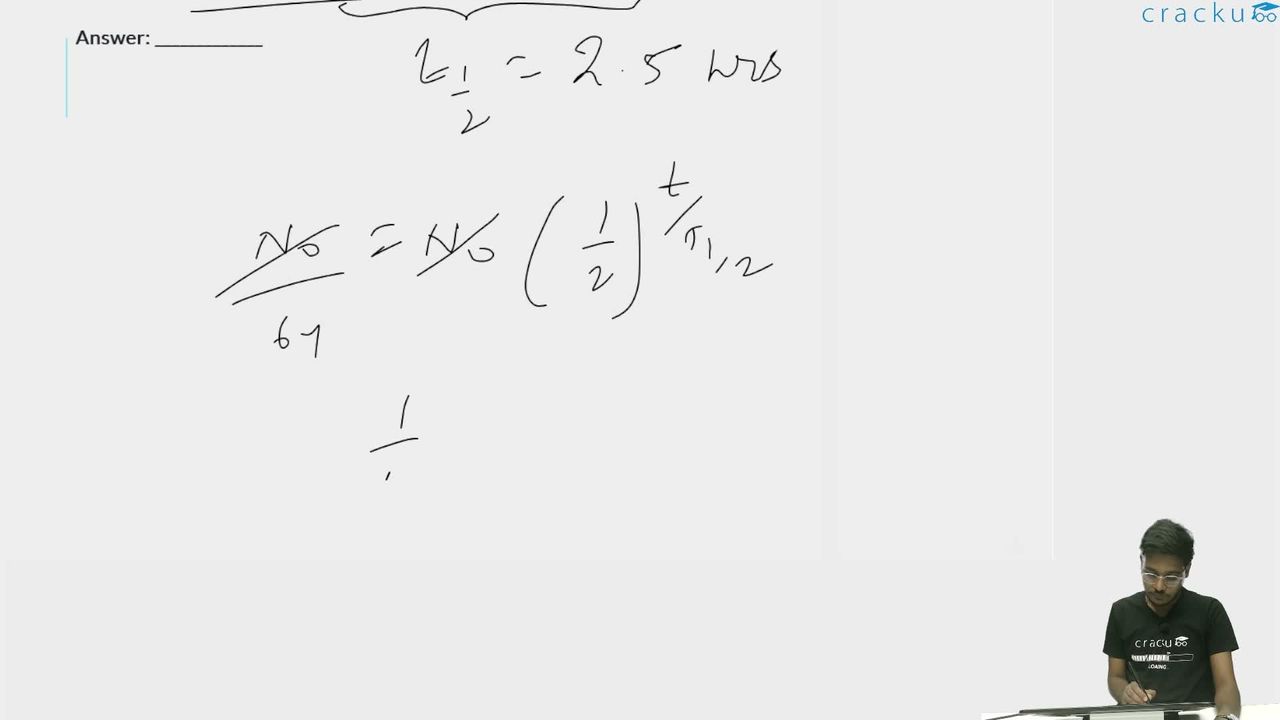
We are given that a radioactive source has a half-life of 2 hours 30 minutes (= 2.5 hours) and initially emits radiation that is 64 times the permissible safe level.
We need to find the time after which the radiation level drops to the permissible safe level.
The radiation intensity is proportional to the activity, which decays as:
$$A = A_0 \left(\frac{1}{2}\right)^{t/T_{1/2}}$$
We need the activity to reduce to $$\frac{1}{64}$$ of the initial value:
$$\frac{A}{A_0} = \frac{1}{64}$$
$$\left(\frac{1}{2}\right)^{t/T_{1/2}} = \frac{1}{64}$$
Since $$\frac{1}{64} = \left(\frac{1}{2}\right)^6$$:
$$\frac{t}{T_{1/2}} = 6$$
$$t = 6 \times T_{1/2} = 6 \times 2.5 = 15 \text{ hours}$$
Therefore, the minimum time after which it would be safe to work with the source is 15 hours.
Was this solution helpful?
Click on the Email ☝️ to Watch the Video Solution
Create a FREE account and get:
_1.webp)

Educational materials for JEE preparation

Ask our AI anything

AI can make mistakes. Please verify important information.
AI can make mistakes. Please verify important information.
