
Join Our JEE Preparation Group
Prep with like-minded aspirants; Get access to free daily tests and study material.
Sign in
Please select an account to continue using cracku.in
↓ →
Join Our JEE Preparation Group
Prep with like-minded aspirants; Get access to free daily tests and study material.
The motion of a mass on a spring, with spring constant $$K$$ is as shown in figure.
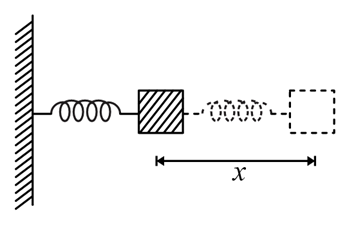
The equation of motion is given by, $$x(t) = A\sin\omega t + B\cos\omega t$$ with $$\omega = \sqrt{\frac{K}{m}}$$. Suppose that at time $$t = 0$$, the position of mass is $$x(0)$$ and velocity $$v(0)$$, then its displacement can also be represented as $$x(t) = C\cos(\omega t - \phi)$$, where $$C$$ and $$\phi$$ are:
We need to find the constants $$C$$ and $$\phi$$ when the equation of motion of a mass on a spring is represented in the cosine form, given its initial position $$x(0)$$ and initial velocity $$v(0)$$ at $$t = 0$$.
The displacement of the mass can be written in two equivalent ways:
$$\text{Form 1: } x(t) = A \sin \omega t + B \cos \omega t \quad \text{--- (Equation 1)}$$
$$\text{Form 2: } x(t) = C \cos(\omega t - \phi) \quad \text{--- (Equation 2)}$$
Using the trigonometric identity $$\cos(\alpha - \beta) = \cos \alpha \cos \beta + \sin \alpha \sin \beta$$, we can expand Equation 2:
$$x(t) = C (\cos \omega t \cos \phi + \sin \omega t \sin \phi)$$
$$x(t) = (C \sin \phi) \sin \omega t + (C \cos \phi) \cos \omega t \quad \text{--- (Equation 3)}$$
Comparing the coefficients of $$\sin \omega t$$ and $$\cos \omega t$$ between Equation 1 and Equation 3, we get:
$$A = C \sin \phi \quad \text{--- (Equation 4)}$$
$$B = C \cos \phi \quad \text{--- (Equation 5)}$$
Let's find the values of $$A$$ and $$B$$ using the position and velocity at $$t = 0$$:
$$x(0) = A \sin(0) + B \cos(0) \implies B = x(0)$$
$$v(t) = \frac{dx}{dt} = A \omega \cos \omega t - B \omega \sin \omega t$$
Now, substitute $$t = 0$$ into this velocity equation:$$v(0) = A \omega \cos(0) - B \omega \sin(0) \implies v(0) = A \omega \implies A = \frac{v(0)}{\omega}$$
Now substitute the expressions for $$A$$ and $$B$$ back into our coefficient relations (Equation 4 and Equation 5):
$$C \sin \phi = \frac{v(0)}{\omega}$$
$$C \cos \phi = x(0)$$
$$C^2 \sin^2 \phi + C^2 \cos^2 \phi = \left(\frac{v(0)}{\omega}\right)^2 + [x(0)]^2$$
$$C^2 = \frac{v(0)^2}{\omega^2} + x(0)^2 \implies C = \sqrt{\frac{v(0)^2}{\omega^2} + x(0)^2}$$
$$\tan \phi = \frac{C \sin \phi}{C \cos \phi} = \frac{\frac{v(0)}{\omega}}{x(0)} = \frac{v(0)}{x(0)\omega}$$
$$\phi = \tan^{-1}\left(\frac{v(0)}{x(0)\omega}\right)$$
Final Answer: Option D: $$C = \sqrt{\frac{v(0)^2}{\omega^2} + x(0)^2}$$, $$\phi = \tan^{-1}\left(\frac{v(0)}{x(0)\omega}\right)$$
Was this solution helpful?
Create a FREE account and get:
_1.webp)

Educational materials for JEE preparation

Ask our AI anything

AI can make mistakes. Please verify important information.
AI can make mistakes. Please verify important information.
