
Join Our JEE Preparation Group
Prep with like-minded aspirants; Get access to free daily tests and study material.
Sign in
Please select an account to continue using cracku.in
↓ →
Join Our JEE Preparation Group
Prep with like-minded aspirants; Get access to free daily tests and study material.
The coefficient of $$x^{48}$$ in $$ (1+x) + 2(1+x)^{2}+3(1+x)^{3}+....+100(1+x)^{100} $$ is equal to
To find the coefficient of $$x^{48}$$ in $$S = \sum_{k=1}^{100} k(1+x)^k$$, we use the derivative of a geometric series.
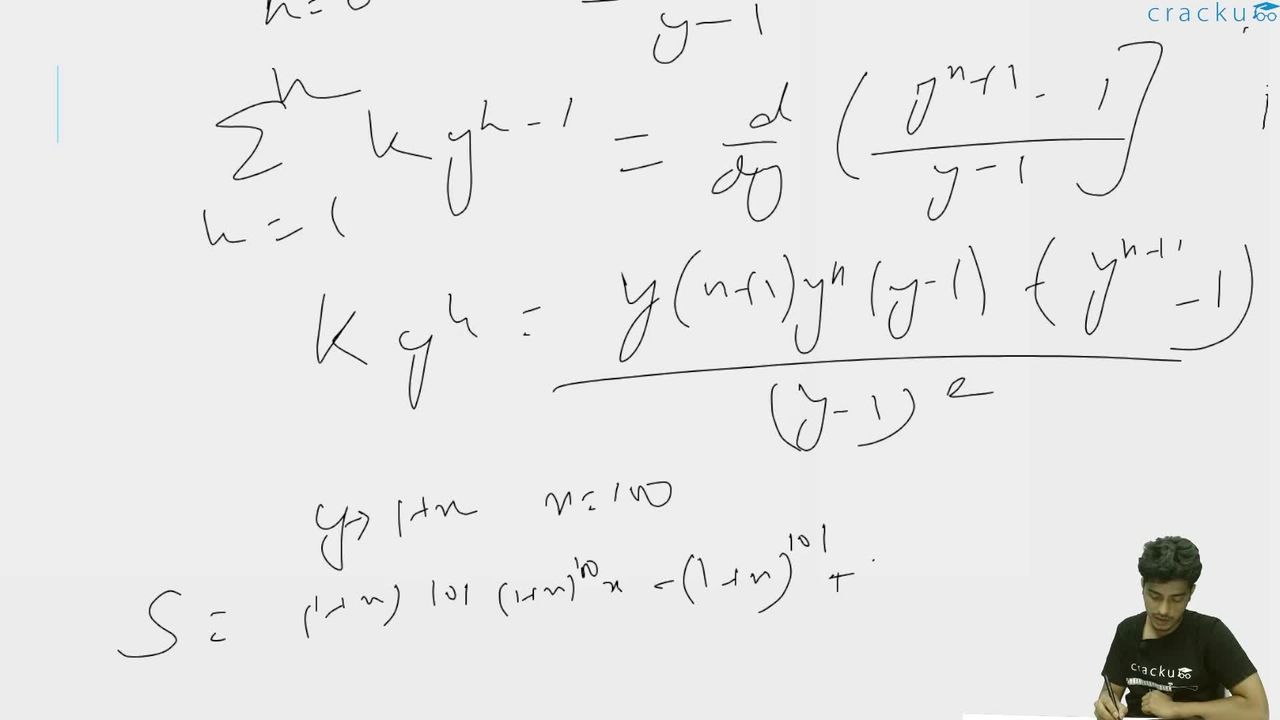
We know that for a geometric series $$\sum_{k=0}^{n} y^k = \frac{y^{n+1}-1}{y-1}$$. Differentiating both sides with respect to $$y$$:
$$\sum_{k=1}^{n} ky^{k-1} = \frac{d}{dy} \left[ \frac{y^{n+1}-1}{y-1} \right]$$
Multiplying by $$y$$ to match our series form:
$$\sum_{k=1}^{n} ky^k = y \frac{(n+1)y^n(y-1) - (y^{n+1}-1)}{(y-1)^2}$$
Let $$y = (1+x)$$ and $$n = 100$$. Since $$y-1 = x$$:
$$S = \frac{(1+x) [101(1+x)^{100}(x) - (1+x)^{101} + 1]}{x^2}$$
$$S = \frac{101(1+x)^{101}}{x} - \frac{(1+x)^{102}}{x^2} + \frac{1+x}{x^2}$$
Total coefficient $$= 101 \binom{101}{49} - \binom{102}{50}$$.
Using the identity $$\binom{n}{r} = \binom{n-1}{r} + \binom{n-1}{r-1}$$ on the second term:
$$= 101 \binom{101}{49} - \left[ \binom{101}{50} + \binom{101}{49} \right]$$
$$= 100 \binom{101}{49} - \binom{101}{50}$$
Was this solution helpful?
Click on the Email ☝️ to Watch the Video Solution
Create a FREE account and get:
_1.webp)

Educational materials for JEE preparation

Ask our AI anything

AI can make mistakes. Please verify important information.
AI can make mistakes. Please verify important information.
