
Join Our JEE Preparation Group
Prep with like-minded aspirants; Get access to free daily tests and study material.
Sign in
Please select an account to continue using cracku.in
↓ →
Join Our JEE Preparation Group
Prep with like-minded aspirants; Get access to free daily tests and study material.
As shown in figure, a 70 kg garden roller is pushed with a force of $$\vec{F} = 200$$ N at an angle of 30° with horizontal. The normal reaction on the roller is (Given $$g = 10$$ m s$$^{-2}$$)
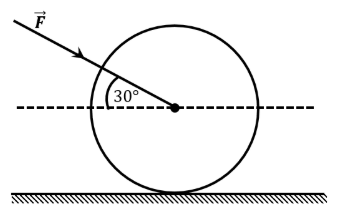
A garden roller of mass 70 kg is pushed with a force of 200 N at 30 degrees below the horizontal. We need to find the normal reaction.
To begin,
Three forces act on the roller:
1. Weight $$W = mg = 70 \times 10 = 700$$ N (acting downward)
2. Applied force $$F = 200$$ N at 30 degrees below the horizontal (has both horizontal and vertical components)
3. Normal reaction $$N$$ from the ground (acting upward)
Next,
Since the force is applied at 30 degrees below the horizontal:
Horizontal component: $$F_x = F\cos 30° = 200 \times \frac{\sqrt{3}}{2} = 100\sqrt{3}$$ N (forward)
Vertical component: $$F_y = F\sin 30° = 200 \times \frac{1}{2} = 100$$ N (downward, since the force is below the horizontal)
From here,
Since the roller moves horizontally (no vertical acceleration), the net vertical force must be zero. The upward force (normal reaction) must balance all downward forces (weight + vertical component of applied force):
$$ N = mg + F\sin 30° $$
$$ N = 700 + 100 = 800\;\text{N} $$
Note: The vertical component of the applied force acts downward because the force is directed below the horizontal. This increases the normal reaction beyond just the weight of the roller. If the force were directed above the horizontal, the vertical component would reduce the normal reaction.
The normal reaction on the roller is 800 N.
The correct answer is Option 3: 800 N.
Was this solution helpful?
Create a FREE account and get:
_1.webp)

Educational materials for JEE preparation

Ask our AI anything

AI can make mistakes. Please verify important information.
AI can make mistakes. Please verify important information.
