
Join Our JEE Preparation Group
Prep with like-minded aspirants; Get access to free daily tests and study material.
Sign in
Please select an account to continue using cracku.in
↓ →
Join Our JEE Preparation Group
Prep with like-minded aspirants; Get access to free daily tests and study material.
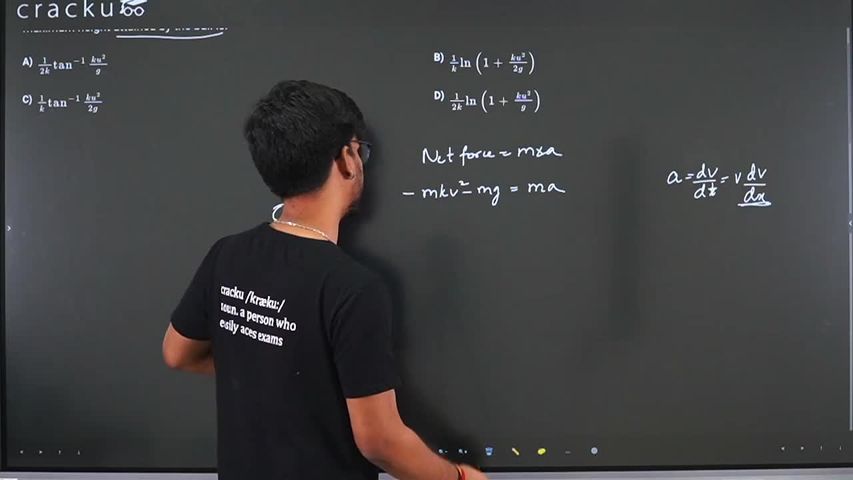
A small ball of mass $$m$$ is thrown upward with velocity $$u$$ from the ground. The ball experiences a resistive force $$mkv^2$$ where $$v$$ is its speed. The maximum height attained by the ball is:
We begin with the forces acting while the ball is moving upward. Its weight acts downward with magnitude $$mg$$ and the given resistive force, proportional to the square of speed, also acts downward with magnitude $$mkv^{2}$$. Taking the upward direction as positive, the net force is downward, so Newton’s second law gives
$$m\,\dfrac{dv}{dt}= -\,mg \;-\; m\,k\,v^{2}.$$
We cancel the common factor $$m$$ to simplify:
$$\dfrac{dv}{dt}= -\,g \;-\; k\,v^{2}.$$
To connect velocity with height, we use the chain‐rule identity for acceleration,
$$a = \dfrac{dv}{dt}=v\,\dfrac{dv}{dy},$$
because $$\dfrac{dy}{dt}=v$$. Substituting this into the equation of motion gives
$$v\,\dfrac{dv}{dy}= -\,g \;-\; k\,v^{2}.$$
We now separate the variables $$v$$ and $$y$$ completely:
$$\dfrac{v\,dv}{g+k\,v^{2}} = -\,dy.$$
The ball starts from the ground with speed $$u$$, so at $$y=0$$ we have $$v=u$$. At the highest point the speed becomes zero, so at $$y=H$$ we have $$v=0$$. We therefore integrate between these limits.
Left-hand integral: let $$s=v^{2} \implies ds = 2v\,dv \implies v\,dv=\dfrac{ds}{2}$$. Hence
$$\int_{u}^{0}\dfrac{v\,dv}{g+k\,v^{2}} \;=\; \dfrac12\int_{u^{2}}^{0}\dfrac{ds}{g+k\,s}.$$
The standard integral $$\displaystyle\int \dfrac{ds}{g+k\,s}= \dfrac{1}{k}\ln (g+k\,s)$$ gives
$$\dfrac12\!\left[\dfrac{1}{k}\,\ln(g+k\,s)\right]_{u^{2}}^{0} \;=\; \dfrac{1}{2k}\Bigl[\ln(g)-\ln\!\bigl(g+k\,u^{2}\bigr)\Bigr].$$
This simplifies to
$$\dfrac{1}{2k}\,\ln\!\left(\dfrac{g}{g+k\,u^{2}}\right) \;=\; -\,\dfrac{1}{2k}\,\ln\!\left(1+\dfrac{k\,u^{2}}{g}\right).$$
Right-hand integral:
$$\int_{0}^{H}(-\,dy)= -\,H.$$
Equating the two evaluated integrals,
$$-\,\dfrac{1}{2k}\,\ln\!\left(1+\dfrac{k\,u^{2}}{g}\right)= -\,H.$$
Both sides carry the same negative sign, so we multiply by $$-1$$ and obtain the maximum height $$H$$:
$$H=\dfrac{1}{2k}\,\ln\!\left(1+\dfrac{k\,u^{2}}{g}\right).$$
This matches option D.
Hence, the correct answer is Option D.
Was this solution helpful?
Click on the Email ☝️ to Watch the Video Solution
Create a FREE account and get:
_1.webp)

Educational materials for JEE preparation

Ask our AI anything

AI can make mistakes. Please verify important information.
AI can make mistakes. Please verify important information.


