
Join Our JEE Preparation Group
Prep with like-minded aspirants; Get access to free daily tests and study material.
Sign in
Please select an account to continue using cracku.in
↓ →
Join Our JEE Preparation Group
Prep with like-minded aspirants; Get access to free daily tests and study material.
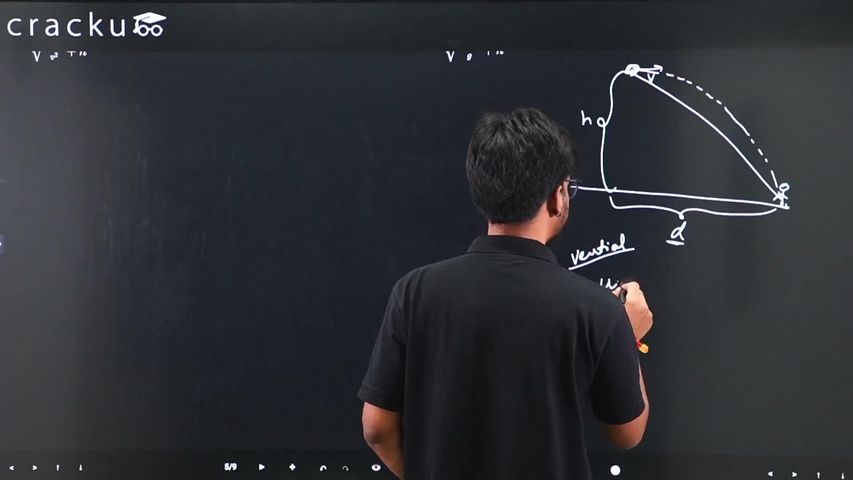
A helicopter is flying horizontally with a speed $$v$$ at an altitude $$h$$ has to drop a food packet for a man on the ground. What is the distance of helicopter from the man when the food packet is dropped?
We have a helicopter moving horizontally with a constant speed $$v$$ at a constant altitude $$h$$ above the ground. The pilot wants to drop a food packet so that it lands exactly on a man who is standing on the ground at some horizontal distance ahead of the helicopter.
At the instant of release the packet has no vertical velocity relative to the helicopter, so its initial vertical component of velocity is zero. Immediately after release it is acted upon only by gravity and thus performs free-fall motion in the vertical direction while continuing to move horizontally with the unchanged speed $$v$$ (because air resistance is neglected).
First we determine the time taken by the packet to reach the ground. In uniform gravitational field the vertical displacement under free fall with zero initial vertical velocity is given by the kinematic equation
$$y = \frac12 g t^2,$$
where $$y$$ is the vertical distance fallen, $$g$$ is the acceleration due to gravity and $$t$$ is the time of fall. Here $$y = h,$$ so
$$h = \frac12 g t^2.$$
Solving this for $$t$$ we get
$$t^2 = \frac{2h}{g} \quad\Longrightarrow\quad t = \sqrt{\frac{2h}{g}}.$$
During this same time interval the packet (and hence the helicopter itself at the instant of release) covers a horizontal distance, because horizontally it continues to move with speed $$v$$. The horizontal distance $$x$$ travelled in the time $$t$$ is obtained from the definition of uniform motion
$$x = v t.$$
Substituting the expression for $$t$$ just found, we obtain
$$x = v \left( \sqrt{\frac{2h}{g}} \right) = v \sqrt{\frac{2h}{g}}.$$
This $$x$$ is the horizontal separation between the helicopter and the man at the instant the packet is dropped.
However, the question asks for the distance of the helicopter from the man at that moment. The helicopter is at height $$h$$ vertically above the ground, and it is horizontally $$x$$ metres ahead of the man. Therefore the straight-line distance $$d$$ between the helicopter and the man is the hypotenuse of a right-angled triangle whose perpendicular sides are $$h$$ and $$x$$. By the Pythagorean theorem,
$$d = \sqrt{\,x^2 + h^2\,}.$$
We already have $$x^2$$:
$$x^2 = \left(v \sqrt{\frac{2h}{g}}\right)^2 = v^2 \left(\frac{2h}{g}\right) = \frac{2 v^2 h}{g}.$$
Substituting this into the expression for $$d$$ gives
$$d \;=\; \sqrt{\,\frac{2 v^2 h}{g} + h^2\,}.$$
This matches Option D.
Hence, the correct answer is Option D.
Was this solution helpful?
Click on the Email ☝️ to Watch the Video Solution
Create a FREE account and get:
_1.webp)

Educational materials for JEE preparation

Ask our AI anything

AI can make mistakes. Please verify important information.
AI can make mistakes. Please verify important information.
