
Join Our JEE Preparation Group
Prep with like-minded aspirants; Get access to free daily tests and study material.
Sign in
Please select an account to continue using cracku.in
↓ →
Join Our JEE Preparation Group
Prep with like-minded aspirants; Get access to free daily tests and study material.
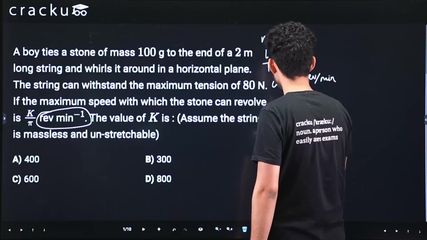
A boy ties a stone of mass $$100$$ g to the end of a $$2$$ m long string and whirls it around in a horizontal plane. The string can withstand the maximum tension of $$80$$ N. If the maximum speed with which the stone can revolve is $$\frac{K}{\pi}$$ rev min$$^{-1}$$. The value of $$K$$ is : (Assume the string is massless and un-stretchable)
We are given: mass of stone $$m = 100$$ g $$= 0.1$$ kg, length of string (radius) $$r = 2$$ m, maximum tension $$T_{max} = 80$$ N.
Apply the condition for circular motion: for horizontal circular motion, the tension provides the centripetal force:
$$ T = m\omega^2 r $$
Find the maximum angular velocity: $$ \omega_{max} = \sqrt{\frac{T_{max}}{mr}} = \sqrt{\frac{80}{0.1 \times 2}} = \sqrt{\frac{80}{0.2}} = \sqrt{400} = 20 \text{ rad/s} $$
Convert angular velocity to revolutions per minute: the relationship between angular velocity and frequency in rev/min is:
$$ \omega = \frac{2\pi n}{60} $$
where $$n$$ is in rev/min.
$$ n = \frac{60\omega}{2\pi} = \frac{60 \times 20}{2\pi} = \frac{1200}{2\pi} = \frac{600}{\pi} \text{ rev/min} $$
Find $$K$$: given that the maximum speed is $$\frac{K}{\pi}$$ rev/min:
$$ \frac{K}{\pi} = \frac{600}{\pi} $$
$$ K = 600 $$
Therefore, the correct answer is Option C.
Was this solution helpful?
Click on the Email ☝️ to Watch the Video Solution
Create a FREE account and get:
_1.webp)

Educational materials for JEE preparation

Ask our AI anything

AI can make mistakes. Please verify important information.
AI can make mistakes. Please verify important information.
