
Join Our JEE Preparation Group
Prep with like-minded aspirants; Get access to free daily tests and study material.
Sign in
Please select an account to continue using cracku.in
↓ →
Join Our JEE Preparation Group
Prep with like-minded aspirants; Get access to free daily tests and study material.
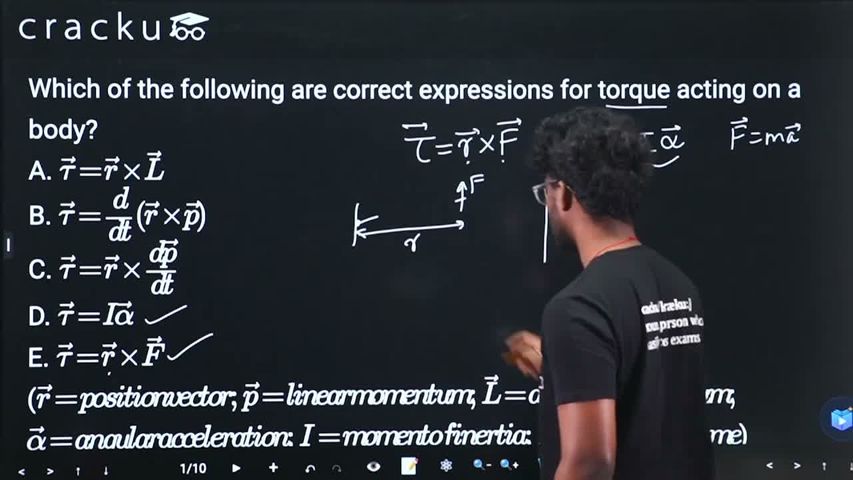
Which of the following are correct expressions for torque acting on a body?
A. $$\vec{\tau} = \vec{r} \times \vec{L}$$
B. $$\vec{\tau} = \dfrac{d}{dt}(\vec{r} \times \vec{p})$$
C. $$\vec{\tau} = \vec{r} \times \dfrac{d\vec{p}}{dt}$$
D. $$\vec{\tau} = I\vec{\alpha}$$
E. $$\vec{\tau} = \vec{r} \times \vec{F}$$
($$\vec{r}= position vector;$$ $$\vec{p}=linear momentum;$$ $$\vec{L}= angular momentum;$$ $$\vec{\alpha} = angular acceleration;$$ $$I = moment of inertia;$$ $$\vec{F} = force; t = time$$)
Choose the correct answer from the options given below :
Torque (moment of the force) about the chosen origin is defined as
$$\vec{\tau} = \vec{r} \times \vec{F} \quad -(1)$$
where $$\vec{r}$$ is the position vector of the point of application of the force $$\vec{F}$$.
Therefore expression E ( $$\vec{\tau} = \vec{r} \times \vec{F}$$ ) is directly correct.
Using Newton’s second law $$\vec{F} = \dfrac{d\vec{p}}{dt}$$ and substituting in $$(1)$$ gives
$$\vec{\tau} = \vec{r} \times \dfrac{d\vec{p}}{dt} \quad -(2)$$
so expression C is also correct.
The orbital angular momentum of the particle is defined as
$$\vec{L} = \vec{r} \times \vec{p} \quad -(3)$$
Differentiating $$(3)$$ with respect to time (for a fixed origin) yields
$$\dfrac{d\vec{L}}{dt} = \dfrac{d}{dt}(\vec{r} \times \vec{p})$$
By the rotational analogue of Newton’s second law, $$\dfrac{d\vec{L}}{dt} = \vec{\tau}$$, hence
$$\vec{\tau} = \dfrac{d}{dt}(\vec{r} \times \vec{p}) \quad -(4)$$
Thus expression B is correct.
For a rigid body of constant moment of inertia $$I$$ about a fixed axis, the relation
$$\vec{\tau}_{\text{net}} = I \vec{\alpha} \quad -(5)$$
holds, where $$\vec{\alpha}$$ is the angular acceleration. Hence expression D is correct under these usual JEE assumptions.
Check expression A: $$\vec{r} \times \vec{L}$$ has dimensions $$\bigl( \text{m}\bigr)\times \bigl(\text{kg m}^2\!/\text{s}\bigr)=\text{kg m}^3\!/\text{s}$$, whereas torque has dimensions $$\text{kg m}^2\!/\text{s}^2$$. The two are not equal, and there is no general mechanical principle equating them. Hence expression A is incorrect.
Therefore the correct expressions are B, C, D and E.
Option C is the correct choice.
Was this solution helpful?
Click on the Email ☝️ to Watch the Video Solution
Create a FREE account and get:
_1.webp)

Educational materials for JEE preparation

Ask our AI anything

AI can make mistakes. Please verify important information.
AI can make mistakes. Please verify important information.
