
Join Our JEE Preparation Group
Prep with like-minded aspirants; Get access to free daily tests and study material.
Sign in
Please select an account to continue using cracku.in
↓ →
Join Our JEE Preparation Group
Prep with like-minded aspirants; Get access to free daily tests and study material.
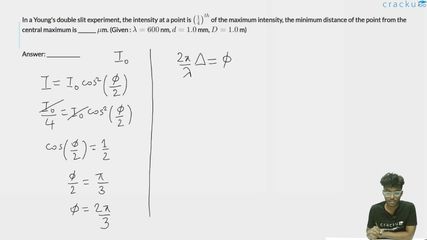
In a Young's double slit experiment, the intensity at a point is $$\left(\frac{1}{4}\right)^{th}$$ of the maximum intensity, the minimum distance of the point from the central maximum is _______ $$\mu$$m. (Given : $$\lambda = 600$$ nm, $$d = 1.0$$ mm, $$D = 1.0$$ m)
Correct Answer: 200
In Young’s double slit experiment, intensity at a point is given by:
$$I = I_{\max}\cos^2\left(\frac{\phi}{2}\right)$$
When $$I = \frac{I_{\max}}{4}$$, we have
$$\cos^2\left(\frac{\phi}{2}\right) = \frac{1}{4} \implies \cos\left(\frac{\phi}{2}\right) = \frac{1}{2} \implies \frac{\phi}{2} = \frac{\pi}{3} \implies \phi = \frac{2\pi}{3}$$
The phase difference is related to the path difference by $$\phi = \frac{2\pi}{\lambda}\Delta$$, where $$\Delta = \frac{yd}{D}$$.
Thus,
$$\frac{2\pi}{3} = \frac{2\pi}{\lambda} \cdot \frac{yd}{D}$$
Rearranging to solve for $$y$$ gives
$$y = \frac{\lambda D}{3d} = \frac{600 \times 10^{-9} \times 1}{3 \times 10^{-3}} = \frac{600 \times 10^{-9}}{3 \times 10^{-3}} = 200 \times 10^{-6} \text{ m} = 200 \text{ }\mu\text{m}$$
Therefore, the answer is $$\boxed{200}$$ μm.
Was this solution helpful?
Click on the Email ☝️ to Watch the Video Solution
Create a FREE account and get:
_1.webp)

Educational materials for JEE preparation

Ask our AI anything

AI can make mistakes. Please verify important information.
AI can make mistakes. Please verify important information.
