
Join Our JEE Preparation Group
Prep with like-minded aspirants; Get access to free daily tests and study material.
Sign in
Please select an account to continue using cracku.in
↓ →
Join Our JEE Preparation Group
Prep with like-minded aspirants; Get access to free daily tests and study material.
If $$2.5 \times 10^{-6}$$ N average force is exerted by a light wave on a non-reflecting surface of 30 cm$$^2$$ area during 40 min of time span, the energy flux of light just before it falls on the surface is ________ W cm$$^{-2}$$. (Round off to the Nearest Integer) (Assume complete absorption and normal incidence conditions are there)
Correct Answer: 25
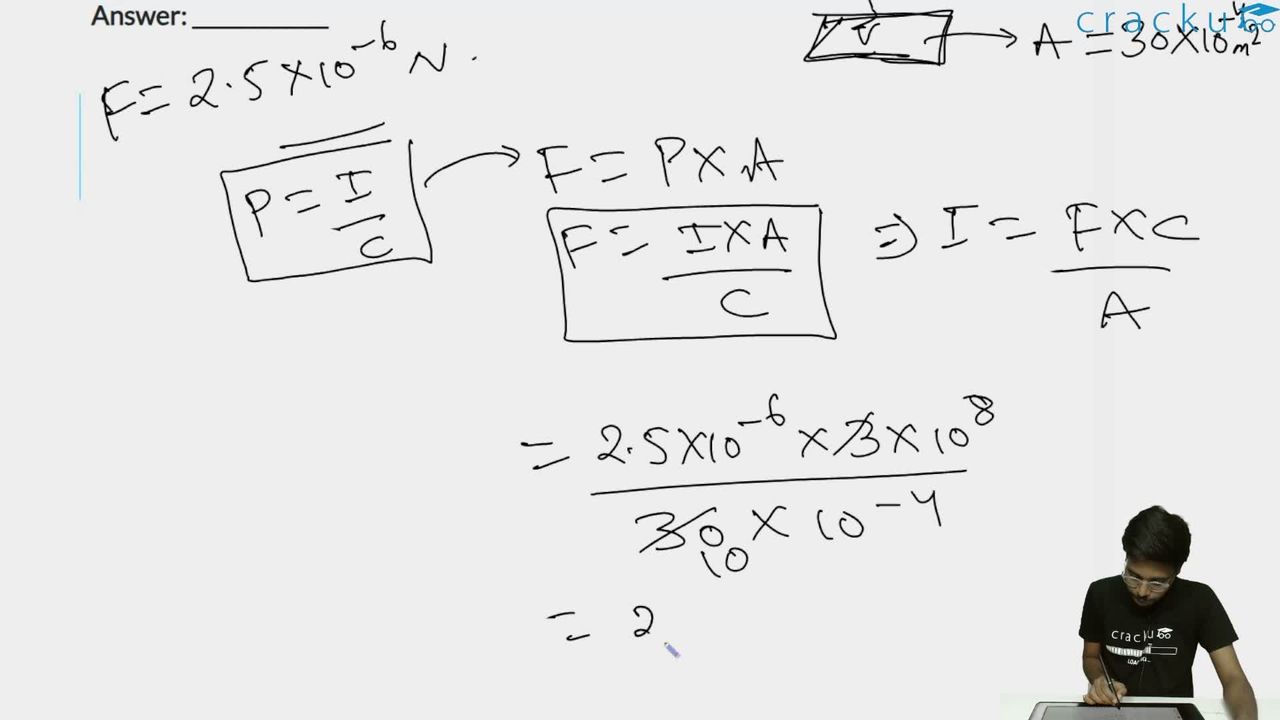
We are given that an average force of $$F = 2.5 \times 10^{-6}$$ N is exerted by a light wave on a non-reflecting (completely absorbing) surface of area $$A = 30 \text{ cm}^2$$ during a time span of $$t = 40$$ min. We need to find the energy flux (intensity) of light.
For complete absorption, the radiation pressure is related to the intensity by $$P = \frac{I}{c}$$, where $$c = 3 \times 10^{8}$$ m/s is the speed of light. Also, the force on the surface equals pressure times area: $$F = P \times A$$.
Combining these, $$F = \frac{I \times A}{c}$$, which gives $$I = \frac{Fc}{A}$$.
Converting the area to m$$^2$$: $$A = 30 \text{ cm}^2 = 30 \times 10^{-4} \text{ m}^2$$. Substituting: $$I = \frac{2.5 \times 10^{-6} \times 3 \times 10^8}{30 \times 10^{-4}} = \frac{7.5 \times 10^2}{30 \times 10^{-4}} = \frac{750}{0.003} = 250000 \text{ W/m}^2$$.
Converting to W cm$$^{-2}$$: since $$1 \text{ m}^2 = 10^4 \text{ cm}^2$$, we have $$I = \frac{250000}{10^4} = 25 \text{ W cm}^{-2}$$.
Therefore, the energy flux of light is $$\boxed{25}$$ W cm$$^{-2}$$.
Was this solution helpful?
Click on the Email ☝️ to Watch the Video Solution
Create a FREE account and get:
_1.webp)

Educational materials for JEE preparation

Ask our AI anything

AI can make mistakes. Please verify important information.
AI can make mistakes. Please verify important information.
