
Join Our JEE Preparation Group
Prep with like-minded aspirants; Get access to free daily tests and study material.
Sign in
Please select an account to continue using cracku.in
↓ →
Join Our JEE Preparation Group
Prep with like-minded aspirants; Get access to free daily tests and study material.
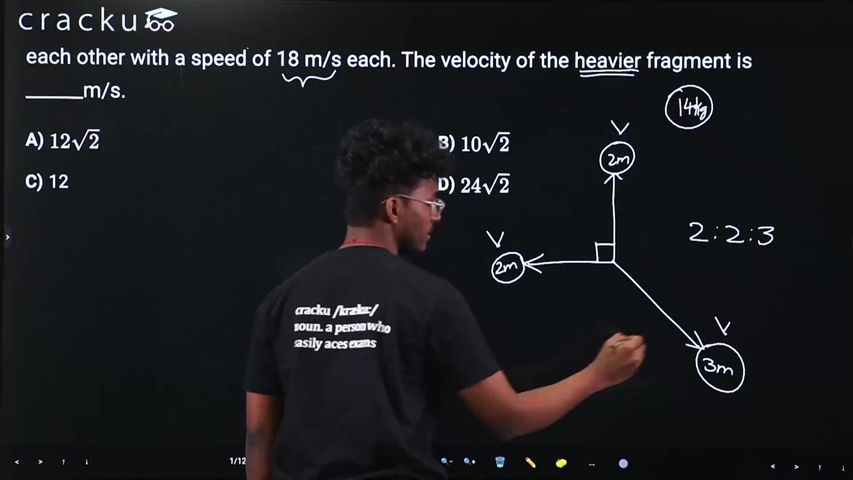
A body of mass 14 kg initially at rest explodes and breaks into three fragments of masses in the ratio 2 : 2 : 3. The two pieces of equal masses fly off perpendicular to each other with a speed of 18 m/s each. The velocity of the heavier fragment is ______m/s.
We need to find the velocity of the heavier fragment after an explosion of a 14 kg body at rest. Since the body is initially at rest, the total initial momentum is zero and by conservation of linear momentum the vector sum of momenta of all fragments must also be zero: $$ \vec{p}_1 + \vec{p}_2 + \vec{p}_3 = 0 $$
The total mass of the body is 14 kg, and the ratio of the masses of the three fragments is 2 : 2 : 3, so the fragments have masses $$m_1 = \frac{2}{7} \times 14 = 4 \, \text{kg},$$ $$m_2 = \frac{2}{7} \times 14 = 4 \, \text{kg},$$ and $$m_3 = \frac{3}{7} \times 14 = 6 \, \text{kg}.$$
The two equal pieces move perpendicular to each other at 18 m/s. Assigning piece 1 to the x-axis and piece 2 to the y-axis gives momenta $$\vec{p}_1 = 4 \times 18 \, \hat{x} = 72 \, \hat{x} \, \text{kg m/s},$$ $$\vec{p}_2 = 4 \times 18 \, \hat{y} = 72 \, \hat{y} \, \text{kg m/s}.$$
By momentum conservation the third fragment has momentum $$\vec{p}_3 = -(\vec{p}_1 + \vec{p}_2) = -72\hat{x} - 72\hat{y}.$$ The magnitude of this momentum is $$ |\vec{p}_3| = \sqrt{72^2 + 72^2} = 72\sqrt{2} \, \text{kg m/s} $$
The speed of the heavier fragment is then $$ v_3 = \frac{|\vec{p}_3|}{m_3} = \frac{72\sqrt{2}}{6} = 12\sqrt{2} \, \text{m/s} $$
The correct answer is Option A: $$12\sqrt{2}$$ m/s.
Was this solution helpful?
Click on the Email ☝️ to Watch the Video Solution
Create a FREE account and get:
_1.webp)

Educational materials for JEE preparation

Ask our AI anything

AI can make mistakes. Please verify important information.
AI can make mistakes. Please verify important information.
