
Join Our JEE Preparation Group
Prep with like-minded aspirants; Get access to free daily tests and study material.
Sign in
Please select an account to continue using cracku.in
↓ →
Join Our JEE Preparation Group
Prep with like-minded aspirants; Get access to free daily tests and study material.
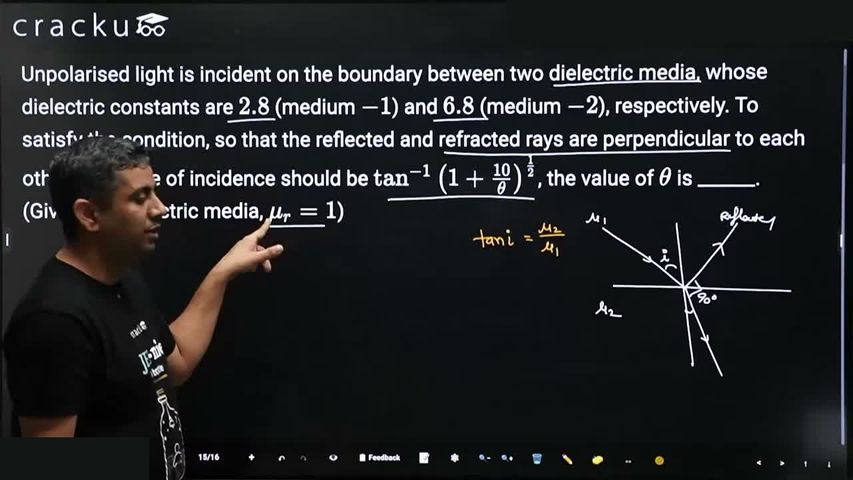
Unpolarised light is incident on the boundary between two dielectric media, whose dielectric constants are $$2.8$$ (medium $$-1$$) and $$6.8$$ (medium $$-2$$), respectively. To satisfy the condition, so that the reflected and refracted rays are perpendicular to each other, the angle of incidence should be $$\tan^{-1}\left(1 + \frac{10}{\theta}\right)^{\frac{1}{2}}$$, the value of $$\theta$$ is ______.
(Given for dielectric media, $$\mu_r = 1$$)
Correct Answer: 7
We need to find the value of $$\theta$$ such that the angle of incidence for total polarization (Brewster's angle) equals $$\tan^{-1}\left(1 + \dfrac{10}{\theta}\right)^{1/2}$$.
At Brewster's angle, the reflected and refracted rays are perpendicular to each other, giving the condition $$\tan i_B = \dfrac{n_2}{n_1}$$.
For dielectric media with $$\mu_r = 1$$, the refractive index is $$n = \sqrt{\varepsilon_r}$$ (since $$n = \sqrt{\mu_r \varepsilon_r}$$).
Thus, $$n_1 = \sqrt{2.8}$$ and $$n_2 = \sqrt{6.8}$$.
It follows that $$\tan i_B = \dfrac{\sqrt{6.8}}{\sqrt{2.8}} = \sqrt{\dfrac{6.8}{2.8}} = \sqrt{\dfrac{68}{28}} = \sqrt{\dfrac{17}{7}}$$.
The given expression for the Brewster angle is $$i_B = \tan^{-1}\left(1 + \dfrac{10}{\theta}\right)^{1/2}$$.
Therefore, $$\tan i_B = \sqrt{1 + \dfrac{10}{\theta}}$$.
Squaring both sides yields $$\dfrac{17}{7} = 1 + \dfrac{10}{\theta}$$.
From this, $$\dfrac{10}{\theta} = \dfrac{17}{7} - 1 = \dfrac{10}{7}$$ and hence $$\theta = 7$$.
The value of $$\theta$$ is $$\boxed{7}$$.
Was this solution helpful?
Click on the Email ☝️ to Watch the Video Solution
Create a FREE account and get:
_1.webp)

Educational materials for JEE preparation

Ask our AI anything

AI can make mistakes. Please verify important information.
AI can make mistakes. Please verify important information.
