
Join Our JEE Preparation Group
Prep with like-minded aspirants; Get access to free daily tests and study material.
Sign in
Please select an account to continue using cracku.in
↓ →
Join Our JEE Preparation Group
Prep with like-minded aspirants; Get access to free daily tests and study material.
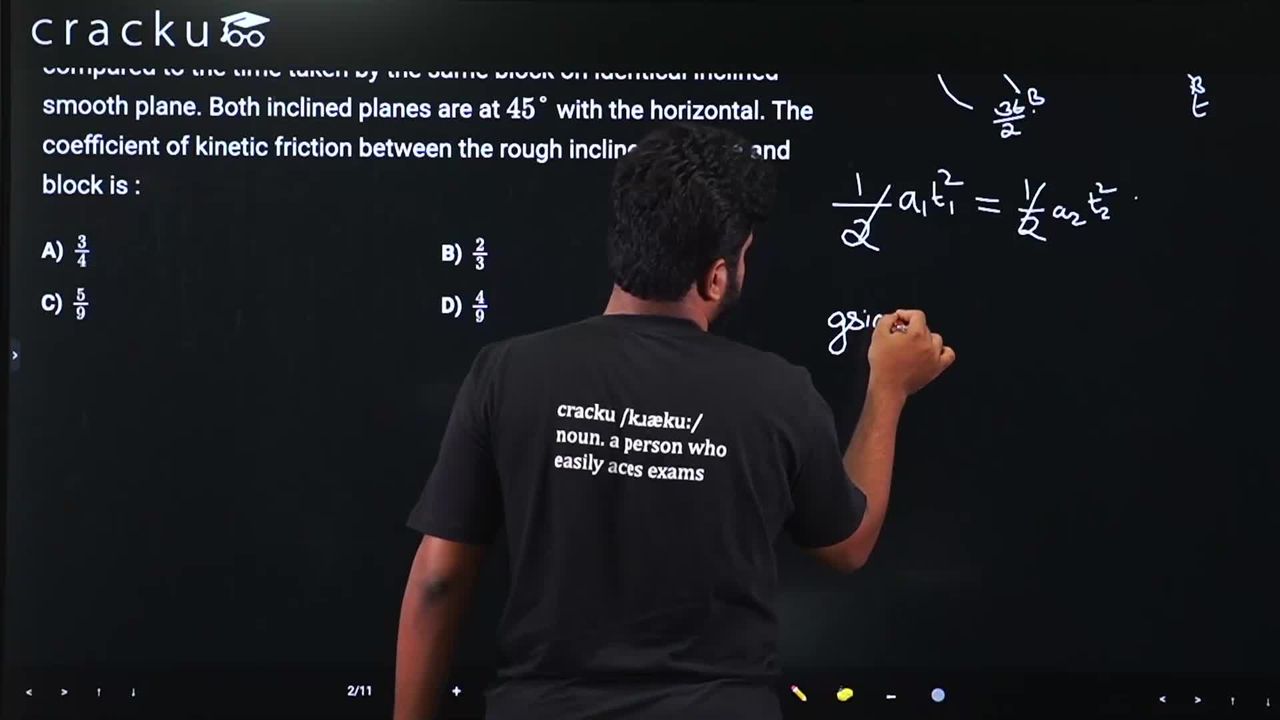
The time taken by a block of mass $$m$$ to slide down from the highest point to the lowest point on a rough inclined plane is 50% more compared to the time taken by the same block on identical inclined smooth plane. Both inclined planes are at $$45°$$ with the horizontal. The coefficient of kinetic friction between the rough inclined surface and block is :
Let the length of the incline (measured along the plane) be $$s$$. The block is released from rest from the top in both cases.
Case 1: Smooth plane
Angle of the plane, $$\theta = 45^{\circ}$$.
Net acceleration down the plane is only the component of gravity:$$a_s = g\sin\theta$$
The time taken to travel the distance $$s$$ starting from rest is obtained from $$s = \tfrac12 a t^2$$, so
$$t_s = \sqrt{\frac{2s}{a_s}}$$
Case 2: Rough plane (kinetic coefficient $$\mu_k = \mu$$)
The force of kinetic friction acts up the plane with magnitude $$\mu N = \mu mg\cos\theta$$.
Net acceleration down the plane:$$a_r = g\sin\theta - \mu g\cos\theta$$
Time taken:$$t_r = \sqrt{\frac{2s}{a_r}}$$
The problem states that $$t_r$$ is 50 % larger than $$t_s$$:$$t_r = 1.5\,t_s$$
Taking the ratio of the two times:
$$\frac{t_r}{t_s} = \sqrt{\frac{2s}{a_r}}\;\Big/\;\sqrt{\frac{2s}{a_s}} = \sqrt{\frac{a_s}{a_r}}$$
Given $$\dfrac{t_r}{t_s}=1.5$$, so$$1.5=\sqrt{\frac{a_s}{a_r}}$$
Squaring both sides:$$\frac{a_s}{a_r}=1.5^2=2.25$$
$$\Rightarrow a_r=\frac{a_s}{2.25}=\frac{4}{9}\,a_s$$
Now substitute the explicit expressions for the accelerations at $$\theta=45^{\circ}$$:
$$a_s = g\sin45^{\circ}= \frac{g}{\sqrt2}$$
$$a_r = g\sin45^{\circ}-\mu g\cos45^{\circ}
= \frac{g}{\sqrt2}\,(1-\mu) = a_s(1-\mu)$$
Using $$a_r = \dfrac{4}{9}a_s$$:
$$a_s(1-\mu)=\frac{4}{9}a_s$$
Cancelling $$a_s$$ (non-zero):$$1-\mu=\frac{4}{9}$$
$$\mu = 1-\frac{4}{9}=\frac{5}{9}$$
Therefore the coefficient of kinetic friction is $$\dfrac{5}{9}$$.
Option C which is: $$\dfrac{5}{9}$$
Was this solution helpful?
Click on the Email ☝️ to Watch the Video Solution
Create a FREE account and get:
_1.webp)

Educational materials for JEE preparation

Ask our AI anything

AI can make mistakes. Please verify important information.
AI can make mistakes. Please verify important information.


