
Join Our JEE Preparation Group
Prep with like-minded aspirants; Get access to free daily tests and study material.
Sign in
Please select an account to continue using cracku.in
↓ →
Join Our JEE Preparation Group
Prep with like-minded aspirants; Get access to free daily tests and study material.
Arrange the following bonds according to their average bond energies in descending order:
C-Cl, C-Br, C-F, C-I
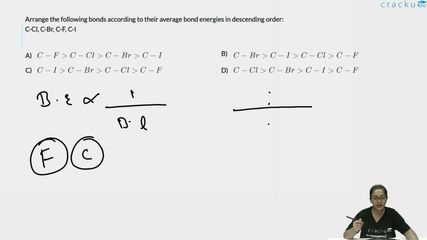
We recall the basic idea that the energy of a covalent bond depends mainly on the extent of overlap between the two atoms’ valence orbitals. A simple proportionality often stated in texts is
$$\text{Bond energy} \;\propto\; \dfrac{1}{\text{Bond length}}$$
because a shorter bond keeps the two nuclei closer, which strengthens the electrostatic attraction between the shared electron pair and both nuclei. Now let us examine the carbon-halogen bonds one by one.
Fluorine has the smallest atomic radius among the halogens. Consequently, the $$\text{C-F}$$ bond length is the shortest in the whole series. Substituting this shortest distance into the inverse relation above, we obtain the largest bond energy for $$\text{C-F}$$.
Chlorine is larger than fluorine but smaller than bromine and iodine. Hence the $$\text{C-Cl}$$ bond length is longer than that of $$\text{C-F}$$ yet shorter than those of $$\text{C-Br}$$ and $$\text{C-I}$$. Therefore its bond energy lies between that of $$\text{C-F}$$ and $$\text{C-Br}$$.
Bromine’s atomic radius is greater than chlorine’s, so the $$\text{C-Br}$$ bond is still longer, leading to a further decrease in bond energy compared with $$\text{C-Cl}$$.
Iodine is the largest halogen in the list. The $$\text{C-I}$$ bond has the greatest bond length, and substituting this maximum distance into the inverse proportionality shows that its bond energy is the smallest of all four bonds.
Putting the individual conclusions together, we write
$$\text{C-F} \;\gt\; \text{C-Cl} \;\gt\; \text{C-Br} \;\gt\; \text{C-I}$$
This sequence matches Option A in the given list.
Hence, the correct answer is Option A.
Was this solution helpful?
Click on the Email ☝️ to Watch the Video Solution
Create a FREE account and get:
_1.webp)

Educational materials for JEE preparation

Ask our AI anything

AI can make mistakes. Please verify important information.
AI can make mistakes. Please verify important information.


